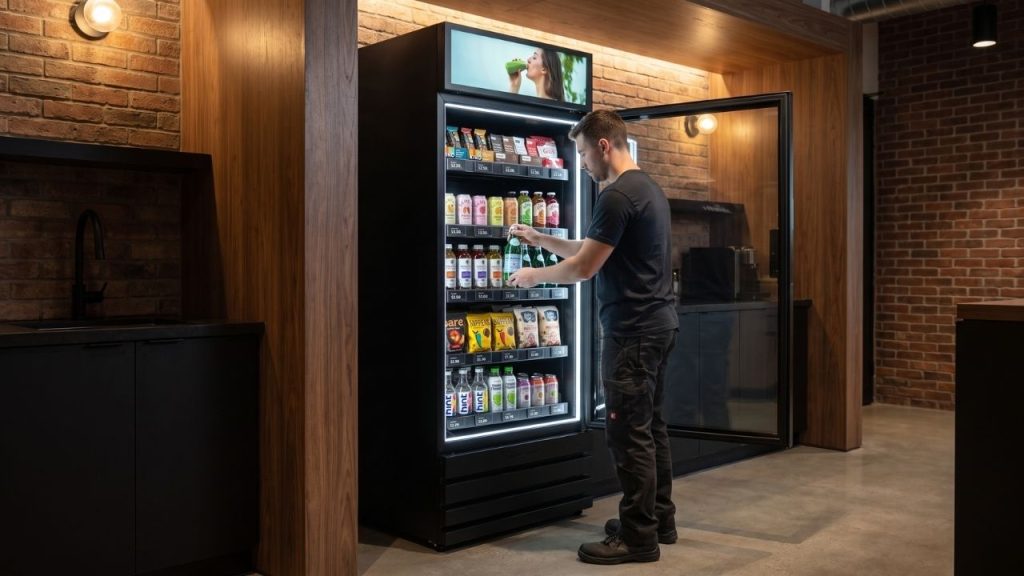
Blog

  • 24/7 Nutrition for Medical Staff: Vending in Healthcare

    24/7 Nutrition for Medical Staff: Vending in Healthcare

    24/7 Nutrition for Medical Staff: Vending in Healthcare

    Healthcare staff need reliable food and beverage access outside normal retail hours. A well-planned smart vending program can help hospitals, clinics, medical office buildings, and healthcare support facilities give staff quick access to meals, snacks, hydration, coffee, and basic essentials without asking clinical or facilities teams to run a retail operation.

    The value is practical. Medical staff often work early mornings, late nights, weekends, holidays, and compressed breaks. If the only options are a closed cafeteria, a delivery app, or leaving campus, the facility has a convenience gap that shows up during ordinary shifts.

    Quick answer

    Smart vending in healthcare is a 24/7 onsite retail setup that gives staff cashless access to food, drinks, and essentials in approved staff or common areas. It works best when the provider manages installation, inventory, stocking, payment support, and maintenance, while the facility provides a suitable indoor location and power.

    This is not a replacement for a cafeteria, employee wellness program, or nutrition strategy. It is a practical support layer for the times when staff need something quickly and the usual food options are closed, inconvenient, or too far away.

    Why healthcare facilities have a different vending need

    Healthcare buildings are not ordinary workplaces. They operate across shifts, departments, security zones, visitor patterns, and service requirements. A nurse coming off a late shift, a resident between rounds, a lab worker on an early schedule, and an overnight facilities team member may all need different things at different times.

    That creates several requirements:

    • access after cafeteria hours
    • products that are more useful than candy and soda alone
    • payment that does not depend on cash
    • placement that does not interfere with patient or visitor flow
    • service that does not become a facilities-team task
    • clear support for refunds, outages, and product issues

    Traditional vending can fill part of the gap, but the product mix and service model often lag behind staff expectations. Smart vending is stronger when it is treated as a managed staff convenience amenity, not just a machine in a hallway.

    What medical staff actually need from onsite vending

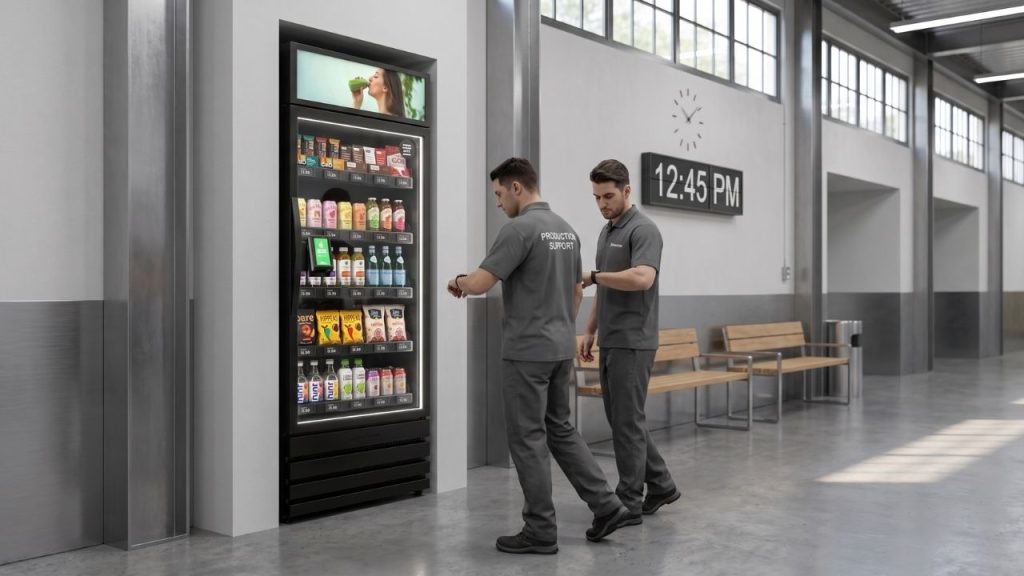
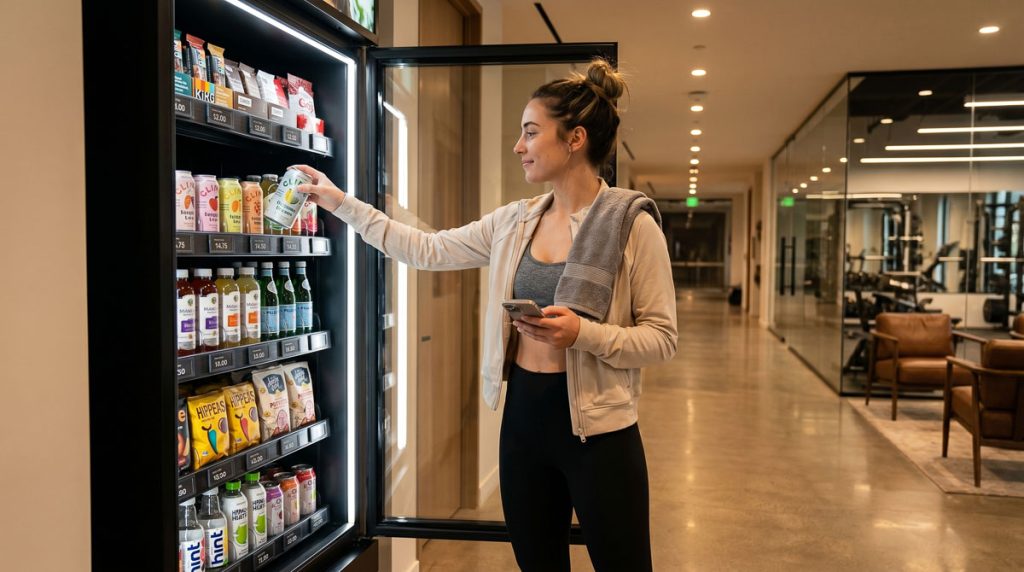
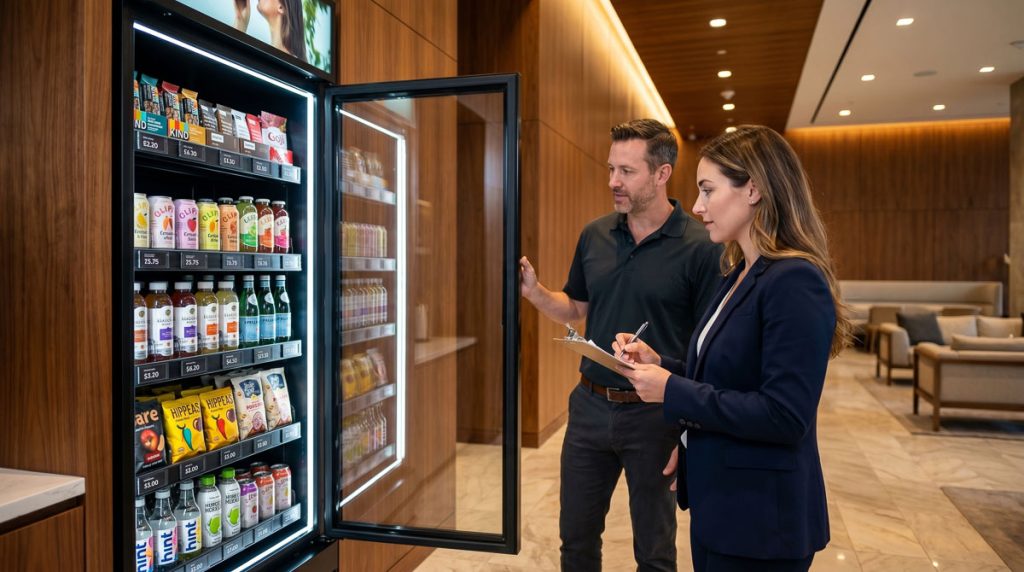
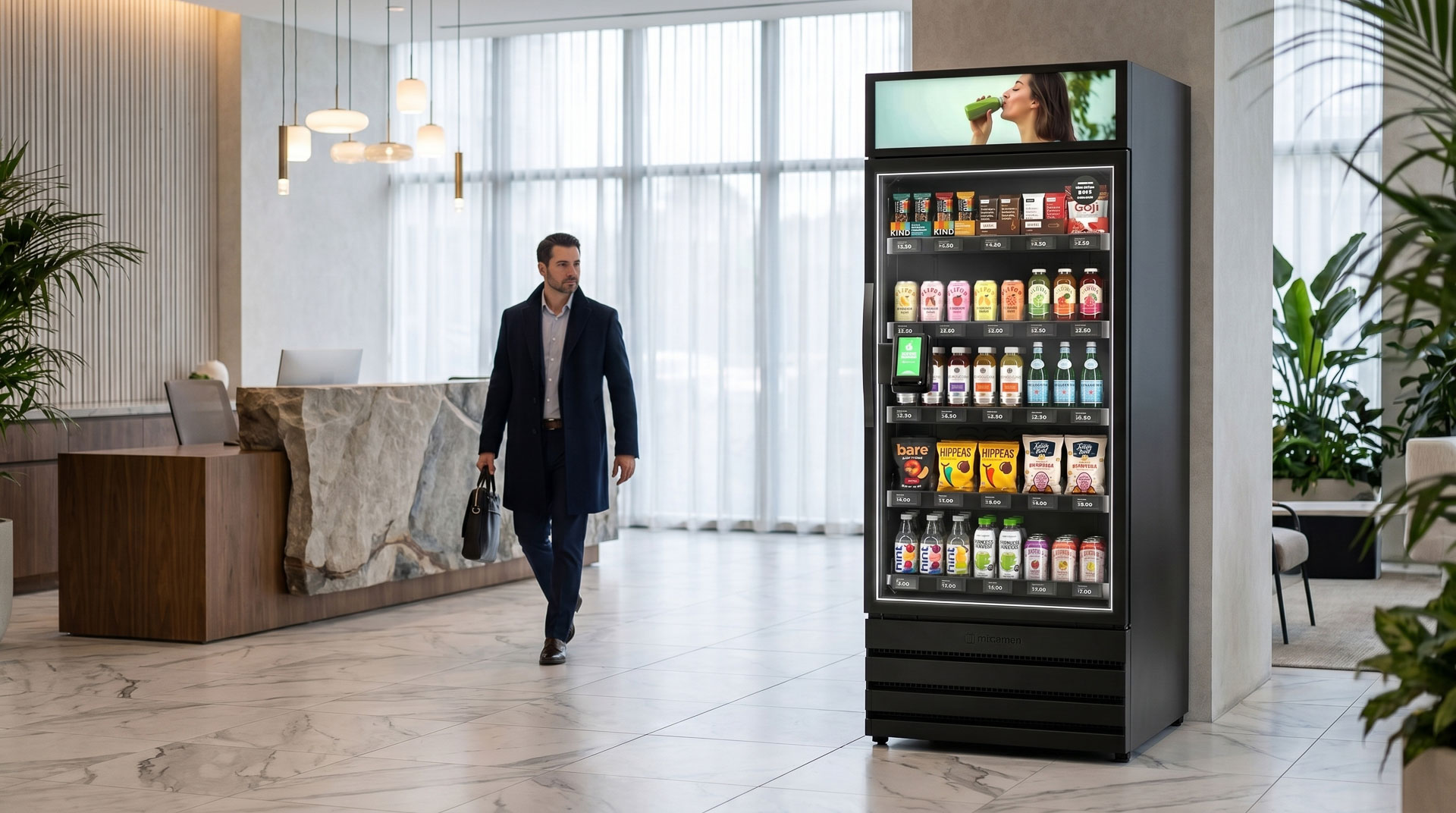
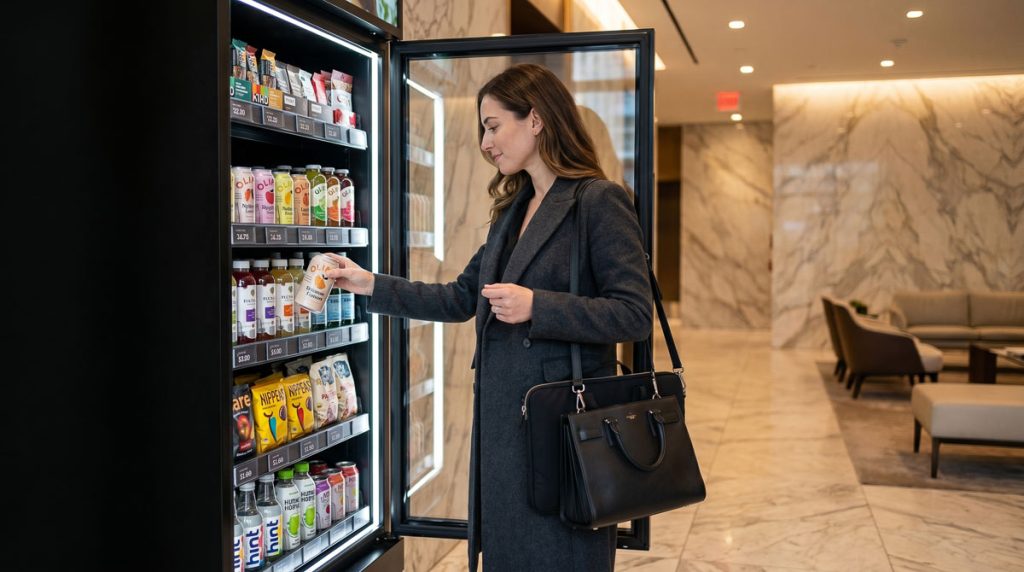
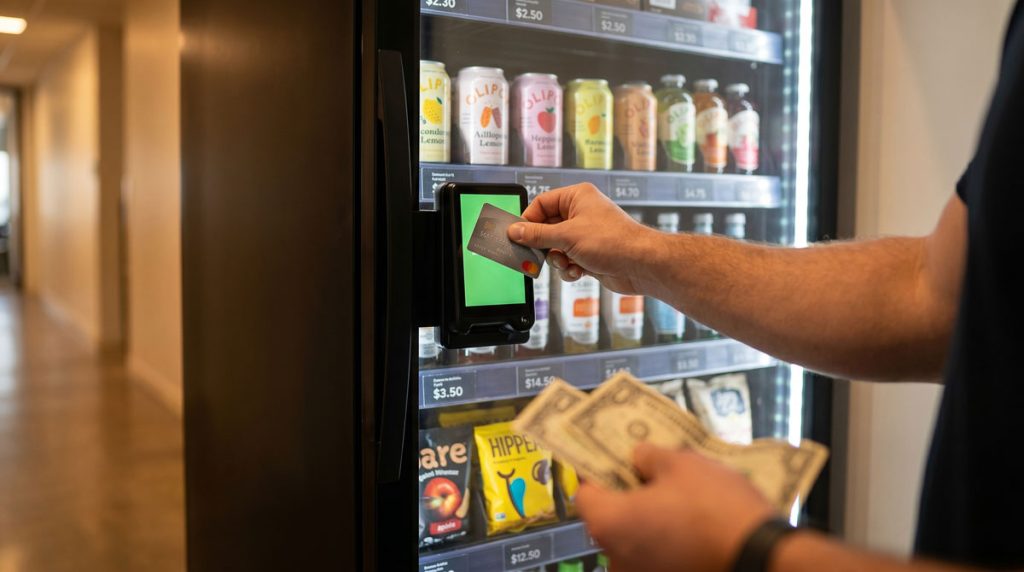
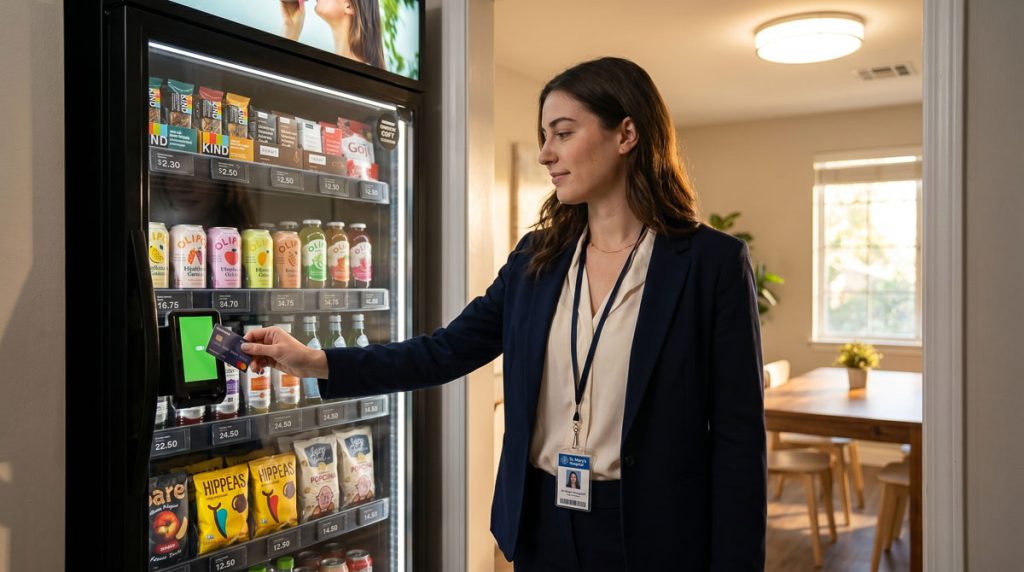
    A nurse tapping a smartwatch on an AI Vending smart cabinet cashless NFC payment 
terminal in a modern hospital corridor, with premium healthy food options visible 
through the glass door

    The product mix should reflect the workday. In healthcare, that often means reliable basics more than novelty products.


    Staff Need

    Useful Product Categories

    Planning Note

    Quick fuel between tasks

    Protein snacks, bars, nuts, sandwiches, wraps

    Prioritize filling options where refrigeration is available

    Hydration

    Water, sparkling water, electrolyte drinks, lower-sugar beverages

    Avoid unsupported health claims

    Overnight coverage

    Coffee, tea, caffeine options, meals, snacks

    Restocking should account for night-shift use

    Forgotten basics

    Toothpaste, deodorant, phone chargers, simple personal care items

    Keep selection limited and practical

    Dietary preferences

    Vegetarian, gluten-free, dairy-free, lower-sugar choices

    Use manufacturer labels, not assumptions

    Facilities should avoid promising that vending will improve health outcomes. The better claim is simpler and more accurate: staff get more practical choices close to where they work.

    Placement matters more in healthcare

    Healthcare placement should be planned carefully. A smart vending unit may work well in a staff lounge, break room, administrative office area, medical office building lobby, or other approved common area. It should not block corridors, emergency access, cleaning routes, security checkpoints, or visitor flow.

    The right placement is visible enough to be used but controlled enough to match the facility’s policies. For staff-focused programs, that often means separating the amenity from patient-facing spaces. For mixed-use medical office buildings, it may mean a common area that serves tenants, staff, and approved visitors without creating congestion.

    Before installation, the provider and facility team should confirm:

    • indoor location
    • power access
    • airflow and clearance
    • service access
    • connectivity needs
    • cleaning expectations
    • who can use the amenity
    • who receives service notifications

    These details matter because healthcare environments already have enough operational complexity.

    Staff-only, visitor-facing, or mixed-use?

    Healthcare vending decisions often start with audience. A staff-only break-room unit should prioritize shift coverage, filling snacks, quick meals, caffeine, hydration, and essentials. A visitor-facing unit needs a cleaner public presentation, simpler product choices, and placement that does not create confusion around patient-care areas.

    Medical office buildings may need a mixed-use approach. Tenants, administrative staff, patients, and visitors may all pass through the same building, but that does not mean every location is right for vending. The facility should decide whether the goal is staff support, tenant convenience, visitor convenience, or a combination.

    That decision affects the product mix, signage, support process, and service schedule. It also helps the provider avoid stocking products that look useful on paper but do not match the actual audience.

    Cashless access helps reduce friction

    Cashless smart vending is a better fit for many healthcare facilities because staff can pay quickly with cards or mobile wallets. It also removes cash handling from the machine and reduces common problems tied to bills, coins, and change.

    For the facility, cashless operation is easier to live with. The provider should own payment processing, refunds, and support, so staff are not bringing vending payment problems to the front desk, nursing leadership, or facilities team.

    The service model is the real difference

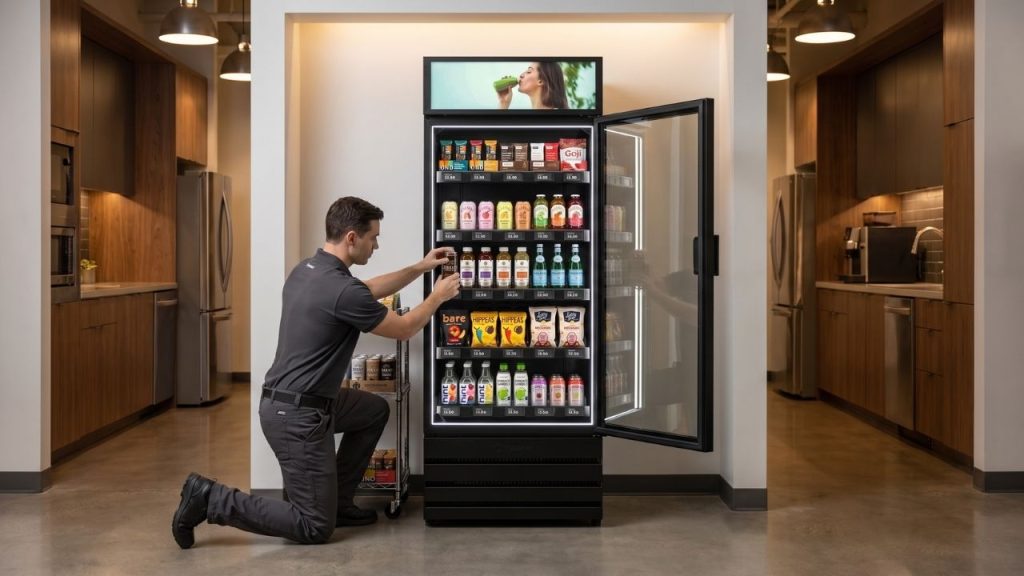
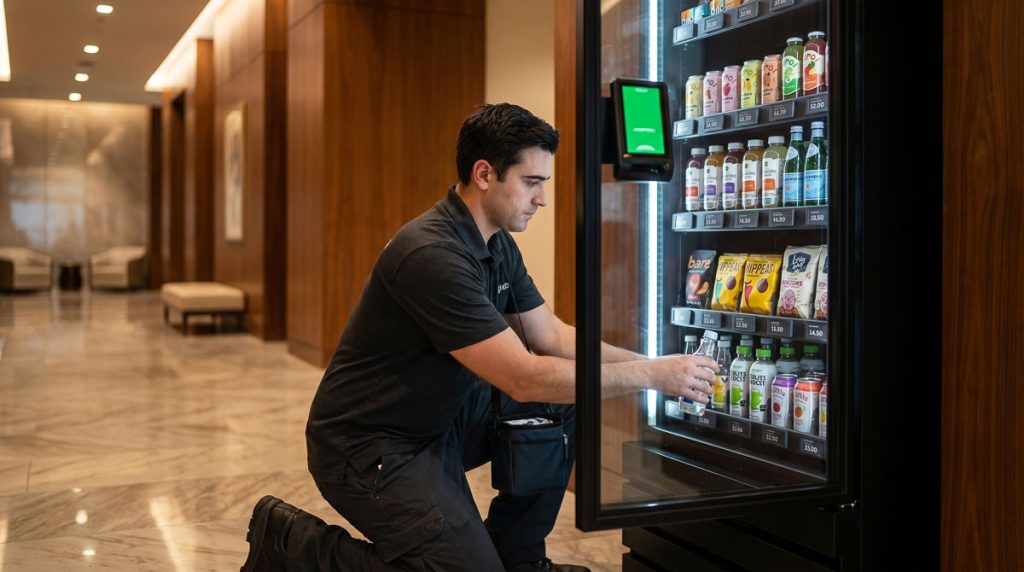
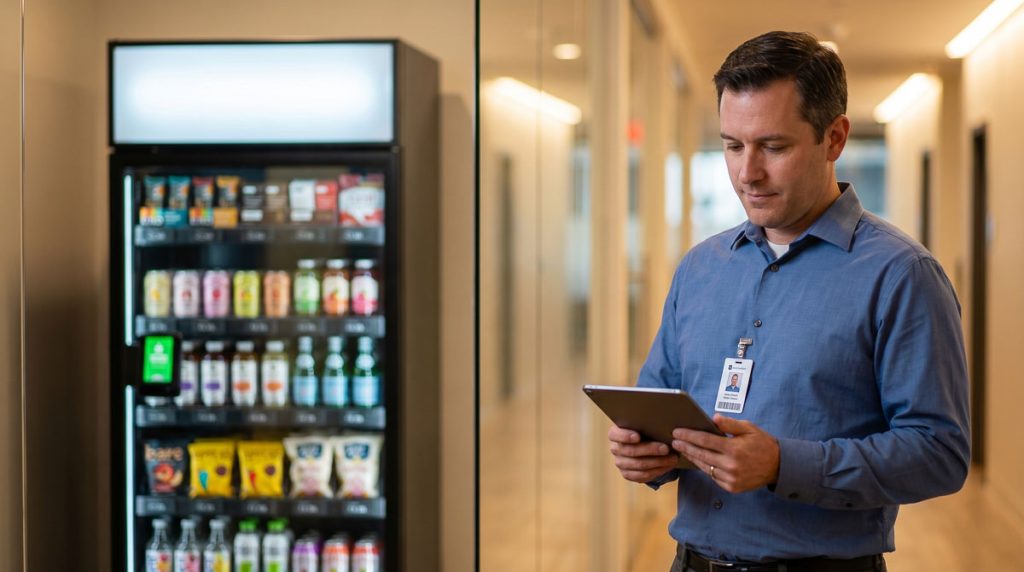
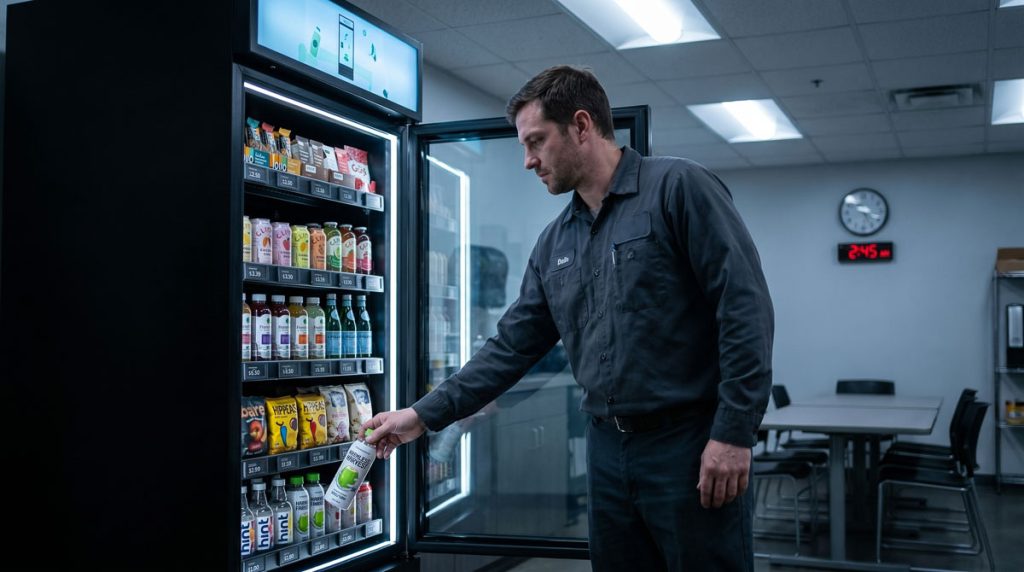
    An AI Vending uniformed service representative wearing gloves and using a tablet 
to restock a smart vending cabinet in a medical office building corridor, with 
hospital staff walking past undisturbed.

    The equipment is only one part of the decision. Healthcare teams should care just as much about who keeps the program stocked, clean, responsive, and useful.

    A full-service model should include:

    • site review before installation
    • product recommendations by audience and location
    • delivery and installation
    • cashless payment setup
    • remote inventory monitoring
    • restocking based on actual usage
    • product changes when items do not sell
    • maintenance and service response
    • customer support for payment or product issues

    AI Vending’s model follows this full-service approach: the facility provides space and power, while the operator handles the equipment, stocking, monitoring, maintenance, and support. That distinction matters in healthcare because staff convenience should not create extra work for clinical or facilities teams.

    What to ask before approving healthcare vending

    Facility leaders should ask practical questions before installation:

    • What product categories do you recommend for our staff schedule?
    • Can the unit support refrigerated items, pantry items, or both?
    • How do you verify dietary or product-label claims?
    • Who handles restocking and service issues?
    • How are refunds and failed payments handled?
    • How often is inventory reviewed?
    • Can the product mix change for night-shift demand?
    • What location requirements do you need?
    • What happens during outages or maintenance windows?
    • What does our staff have to do after installation?

    The answer to the last question should be short. A healthcare vending program works best when facility staff are not expected to manage the retail operation.

    When vending may not be the right fit

    Smart vending may not work well if the only available location is hidden, outdoors, poorly ventilated, hard to service, or too close to sensitive patient-care areas. It may also be the wrong fit if the facility wants fresh meals but cannot support refrigerated equipment, service access, or appropriate product rotation.

    It is also worth being careful with wellness language. Better product access is useful, but the article, signage, and merchandising should not imply medical benefits unless the claim is supported by the manufacturer and appropriate review.

    Build the program around staff routines

    The strongest healthcare vending programs start with staff behavior. Who works overnight? Where do people take breaks? When is the cafeteria closed? Which departments have the least time to leave the building? Which areas are easy to service without disrupting operations?

    Those answers should shape the unit location, product mix, restocking cadence, and support process. The goal is not to add another amenity for its own sake. The goal is to give healthcare staff a reliable way to get useful food, drinks, and essentials when their schedule makes ordinary retail access difficult.

    Support staff without adding work

    24/7 nutrition for medical staff is really about access, reliability, and service responsibility. A smart vending program can support staff during long shifts, overnight coverage, and short breaks, but only if the product mix is useful and the operation stays off the facility team’s plate.


    AI Vending can help Colorado healthcare facilities evaluate placement, shift coverage, product strategy, and service expectations before adding a smart vending amenity.

  • Gym Amenity: Integrated Vending for Fitness Centers

    Gym Amenity: Integrated Vending for Fitness Centers

    Gym Amenity: Integrated Vending for Fitness Centers

    A gym amenity with integrated vending gives members, residents, tenants, or employees convenient access to drinks, protein snacks, quick meals, and essentials near the place they already work out. For fitness centers in Denver properties, the strongest setup is a fully managed smart vending or smart store model that supports wellness routines without asking staff to stock products or handle payment issues.

    The goal is not to make medical or performance claims. The goal is practical convenience: hydration after a workout, a snack before a commute, a quick meal after a class, or a small item someone forgot.

    Quick answer

    Integrated vending for fitness centers places a smart vending cabinet or smart store near a gym, studio, locker area, or fitness-adjacent common space. It can offer water, electrolyte drinks, ready-to-drink coffee, protein items, snacks, meals, and small essentials while the provider handles stocking, monitoring, service, payment support, and product changes.

    For property and facility teams, the best fit is a provider-managed model. The fitness center gets a more useful amenity, and staff do not become the retail operator.

    What integrated vending means

    Integrated vending means the retail amenity is planned around the fitness experience instead of placed randomly in the building. The product mix, cabinet location, payment flow, and service plan should all support how people use the gym.

    That might mean a smart cabinet near an apartment fitness center, an office wellness room, a residential lobby next to the gym corridor, or a standalone fitness center with enough traffic. The key is that the vending amenity feels connected to the workout routine.

    Traditional vending often sits wherever there is room. Integrated vending starts with the use case: what do people need before, during, and after using the fitness space?

    Why fitness centers are a strong fit

    Fitness spaces create predictable convenience moments. People often need hydration, caffeine, protein, or something small before they leave the building. They may also forget basic items or want a quick option after a workout.

    Integrated vending can support:

    • early morning workouts before nearby retail opens
    • evening gym use after leasing or office hours
    • post-workout hydration and snacks
    • quick meals for residents or employees with tight schedules
    • personal care basics and small essentials
    • visitors or guests who did not bring a drink

    For apartment communities, this can make the fitness center feel more complete. For offices, it can support wellness rooms and employee convenience. For standalone gyms, it can add a low-lift retail point if the provider model fits traffic and access.

    Product categories that make sense

    Three people chatting while a man buys a recovery drink at a gym micro-market after a workout.

    Fitness-adjacent vending should be useful without overpromising. Product labels and manufacturer information should support any nutrition or ingredient claims.

    CategoryCommon use caseCaution
    Water and hydration drinksBefore or after workoutsAvoid unsupported performance claims
    Protein snacksMore filling snack optionDo not imply medical or fitness outcomes
    Ready-to-drink coffee and teaMorning or afternoon energy routineKeep caffeine choices balanced
    Better-for-you snacksEveryday convenience near the gymDefine by product facts, not vague health language
    Quick mealsPost-workout or late-day hungerRequires demand tracking and rotation
    Small essentialsForgotten items, personal care basicsKeep the mix focused and clean

    The product mix should start simple. If sales data shows demand for refrigerated meals, higher-protein items, or specific beverages, the provider can adjust.

    Placement and design considerations

    Placement has a direct effect on usage. A smart vending cabinet should be visible enough to feel like part of the amenity, but not placed where it blocks traffic, creates clutter, or interferes with the fitness experience.

    Good placement options include:

    • just outside the fitness center
    • near a locker or towel area
    • in a lobby connected to the gym path
    • near a resident lounge or coworking area used after workouts
    • in an office break area connected to a wellness room

    The location should have appropriate power, safe access, visibility, and enough room for people to browse without crowding the fitness entrance. If the cabinet includes refrigerated products, the provider should confirm ventilation and service access.

    How smart vending improves the operation

    Old vending machines can feel out of place in premium fitness environments. Smart vending can make the experience cleaner and more flexible when the operator manages it well.

    Useful features include:

    • cashless payment
    • glass-front browsing
    • remote inventory monitoring
    • product mix updates based on sales
    • refrigerated, pantry, or freezer formats where appropriate
    • provider-managed restocking and service

    The smart technology should make the amenity easier to use and easier to operate. If the property or fitness staff still have to track inventory, handle refunds, or call repeatedly for service, the model is not doing its job.

    What property and fitness teams should ask

    Before adding integrated vending to a fitness center, ask:

    • Which products are appropriate for a fitness-adjacent setting?
    • How will nutrition, ingredient, and dietary claims be handled?
    • Who restocks, monitors inventory, handles payment issues, and services the cabinet?
    • Can the mix include refrigerated drinks or meals if demand supports it?
    • Where should the cabinet sit so it supports the gym without crowding it?
    • What power, ventilation, connectivity, and service access are required?
    • How often will the product mix be reviewed?

    Good providers will answer in operational terms. They should not rely on vague wellness language or make unsupported health promises.

    When integrated vending may not fit

    Integrated vending may not be right for every fitness center. A low-traffic gym, hidden room, outdoor-only placement, or space with poor power access may underperform. It may also be a weak fit if the audience only wants free water or if staff expect a provider to stock products that do not sell.

    The product strategy should be grounded in actual demand. A cabinet full of niche fitness items can look thoughtful but still fail if people mostly want water, coffee drinks, snacks, and simple meals.

    How AI Vending supports fitness-adjacent amenities

    Smart store technician providing on-site support by restocking product inventory in an automated kiosk.

    AI Vending installs and operates fully managed smart store amenities for Colorado properties. For fitness-adjacent use cases, that means the cabinet, product mix, restocking, monitoring, payment support, and service remain with the operator.

    For a Denver property or facility, a site survey should review gym traffic, adjacent common areas, power, visibility, audience, and product needs. The right setup should make the fitness amenity more useful while keeping the operation simple for staff.

    FAQs

    What should a gym vending machine stock?

    Start with water, hydration drinks, ready-to-drink coffee, protein snacks, better-for-you snacks, quick meals, and small essentials. The exact mix should change based on actual sales data.

    Can vending near a fitness center include meals?

    Yes, if traffic and refrigeration support it. Refrigerated meals require stronger rotation, monitoring, and service discipline than shelf-stable snacks.

    Who manages the products?

    In a fully managed smart vending model, the provider manages product selection, inventory monitoring, restocking, payment support, and service. The property or fitness team should not have to run the retail operation.

    What should a property do next?

    Start with placement and user needs. If the fitness center has regular traffic and a visible location nearby, talk to AI Vending about whether a fully managed smart store can support the amenity.


  • Winning the Denver Amenity War: How Properties Stand Out

    Winning the Denver Amenity War: How Properties Stand Out

    Winning the Denver Amenity War: How Properties Stand Out

    Winning the Denver amenity war is not about adding the loudest feature. Properties stand out when they choose amenities residents actually use, that tour well, and that do not create extra work for the onsite team. A fully managed smart vending or smart store amenity can help because it solves a daily convenience need: quick access to drinks, snacks, meals, and essentials inside the building.

    For Denver property teams, the better question is not “What amenity looks impressive?” It is “What amenity will residents notice, use, and appreciate after move-in?”

    Quick answer

    Denver properties can stand out by prioritizing amenities that are visible, useful, reliable, and operationally simple. Smart vending fits that standard when it gives residents 24/7 convenience while the provider handles stocking, monitoring, payments, service, and product changes.

    It should not be the only amenity strategy. It works best as a practical layer that supports everyday resident routines and makes existing common areas more useful.

    What the amenity war really means

    The phrase “amenity war” can make the market sound like a contest of bigger gyms, flashier lounges, and more expensive finishes. Those features can matter, but residents also judge a property through smaller daily moments.

    Can they grab a drink after the fitness center? Is there a quick meal option when they get home late? Can they get something small without leaving the building? Does the property feel current without making staff manage another program?

    Those practical moments shape resident perception. A property does not always need a dramatic new amenity. Sometimes it needs a better use of the space residents already pass every day.

    The strongest amenities share four traits

    Strong resident amenities usually pass four tests:

    1. They are easy to understand.
    2. Residents use them repeatedly.
    3. They fit the property’s audience and traffic patterns.
    4. They do not create a hidden staff burden.

    Smart vending can pass those tests when it is placed well and fully managed. Residents understand the value immediately. They can use it at different times of day. The product mix can change based on buying behavior. The property team does not have to stock shelves, troubleshoot payments, or monitor inventory.

    The same framework can help evaluate any amenity. If a feature looks good in a brochure but creates low usage, unclear value, or staff frustration, it may not help the property stand out for long.

    Where smart vending fits in the amenity mix

    Woman purchasing a snack from a self-service micro-market inside a modern coworking space lounge.

    Smart vending is most useful when it fills a real gap between larger amenities. A fitness center supports exercise, but residents may want hydration or protein afterward. A coworking lounge supports remote work, but residents may want coffee, snacks, or a quick meal. A package room brings residents to a common area, but it may not offer any everyday convenience.

    That is where a managed smart store can make existing amenities more useful. It does not replace the gym, lounge, or package room. It adds a convenience layer around those spaces.

    Good placements include:

    • lobbies
    • mailrooms and package areas
    • resident lounges
    • coworking areas
    • clubrooms
    • fitness-adjacent spaces
    • laundry rooms
    • parking-level vestibules where appropriate and secure

    The best placement is visible, easy to access, and tied to a resident routine.

    Comparing amenity options

    Every amenity has tradeoffs. Smart vending tends to compete well when the goal is useful daily convenience with low operational lift.

    Amenity optionWhat it can do wellWhat to evaluate
    Fitness upgradeImproves lifestyle value and tours wellCost, maintenance, space, usage concentration
    Coworking loungeSupports remote and hybrid residentsNoise, furniture upkeep, reservation behavior
    Package technologyReduces delivery frictionSpace, carrier adoption, resident education
    Coffee barCreates hospitality and morning valueStocking, cleaning, service ownership
    Smart vending or smart storeAdds 24/7 food, drinks, meals, and essentialsPlacement, product fit, provider service model

    The point is not that smart vending is better than every alternative. The point is that it can make an existing amenity stack more useful without requiring a major buildout.

    What local proof suggests

    Apartment resident buying a late-night snack at an illuminated smart kiosk in a dark lobby.

    AI Vending’s downtown Denver case study, published March 23, 2026, reported 60.7% resident adoption, 30.4% monthly usage, and 25.9% of transactions between 10 PM and 5 AM at an Avenue5 Residential-managed property. The same case study reported 31.7% stronger demand for full meal options than AI Vending’s per-location average.

    Those numbers are not a promise that every property will see the same results. They do show that residents may use onsite retail beyond standard daytime snack trips. Late-night access and meal options can matter when the amenity is placed, stocked, and managed around real behavior.

    For property teams trying to stand out, that is the important lesson. A useful amenity should serve the resident moments that already exist.

    How to avoid amenity bloat

    Amenity bloat happens when a property adds features without a clear resident job. The result can be a crowded amenity package, higher maintenance, and unclear value.

    Smart vending can avoid that problem if the property defines the job first:

    • Serve residents after nearby retail closes.
    • Support remote work and coworking areas.
    • Add food and drink convenience near the fitness center.
    • Make underused lobby or mailroom space more useful.
    • Offer a low-lift convenience option for residents and guests.

    If the job is unclear, the amenity will be harder to evaluate. If the job is clear, the product mix, placement, and service plan become easier to judge.

    What to ask a provider

    Before adding smart vending to an amenity strategy, property teams should ask:

    • Who owns stocking, service, payment support, and product changes?
    • What cabinet format fits our traffic and space?
    • How will the product mix support our resident profile?
    • Can the setup support drinks, snacks, quick meals, and essentials?
    • How often do you review performance and adjust inventory?
    • What happens when a product sells out, a payment issue happens, or equipment needs service?
    • How will the amenity look in a tour path or common area?

    The provider should answer with operational detail. A polished cabinet is only valuable if the service model keeps it stocked and reliable.

    When smart vending will not be enough

    Smart vending is not a full amenity strategy by itself. It will not replace a thoughtful leasing experience, well-maintained common areas, responsive maintenance, strong resident communication, or larger amenities that fit the property’s positioning.

    It also may not be right for a hidden, low-traffic, or poorly powered space. A smart store needs a real resident path and a provider that can manage the operation.

    For the right building, though, it can be a practical differentiator: visible on tours, useful after move-in, and simpler for staff than a self-managed market.

    How AI Vending supports Denver properties

    AI Vending installs and operates fully managed smart store amenities for Colorado properties. That means the cabinet, product curation, restocking, monitoring, payment support, and service stay with the operator.

    For Denver teams looking at the amenity mix, a site survey can clarify whether smart vending belongs in a lobby, mailroom, coworking area, fitness-adjacent space, or another high-traffic common area.

    FAQs

    Is smart vending a luxury amenity?

    It can support a premium amenity package, but its value is practical. Residents use it because it solves everyday convenience needs, not because it is flashy.

    Can smart vending help properties stand out on tours?

    Yes, if it is visible, clean, modern, and easy to explain. It should look like a managed resident convenience point, not an old vending machine hidden away.

    What products matter most?

    Common categories include drinks, coffee beverages, snacks, protein items, quick meals, and small essentials. The best mix depends on resident behavior.

    What should a Denver property do next?

    Start by identifying the resident moments your current amenities do not serve. Then talk to AI Vending about whether a fully managed smart store can fill that gap without adding work for staff.


  • Work-From-Home Amenity Supporting Remote Residents

    Work-From-Home Amenity Supporting Remote Residents

    Work-From-Home Amenity Supporting Remote Residents

    A work-from-home amenity supporting remote residents should make daily life easier inside the building, not just add another feature to the amenity list. For Denver apartment communities, a fully managed smart vending or smart store setup can support residents who work from home by giving them 24/7 access to drinks, snacks, quick meals, and essentials without asking the property team to run a market.

    The best version is practical. It helps residents solve small daily needs between meetings, after workouts, late at night, or during long work blocks while the provider handles stocking, service, payment support, and product updates.

    Quick answer

    A work-from-home vending amenity is an onsite convenience point designed around remote and hybrid resident routines. It can support coffee breaks, midday snacks, quick meals, hydration, personal care basics, and late-night needs through a cashless, provider-managed smart store.

    For property teams, the value is not only convenience. It is a resident experience upgrade that can fit into existing common areas without creating a new staff job.

    Why remote residents use amenities differently

    Remote and hybrid residents spend more weekday hours inside the property. That changes how they use the building. A resident may start the day in a unit, take calls from a coworking lounge, use the fitness center at lunch, pick up packages in the afternoon, and still need something quick before an evening meeting.

    That routine creates small convenience gaps:

    • coffee or cold drinks between calls
    • snacks that do not require leaving the building
    • quick meals when delivery is too slow or expensive
    • hydration after the gym
    • everyday items like gum, pain relief, or personal care basics
    • late-night options when nearby retail is closed

    A property does not need to promise a full workplace experience to support these needs. It can provide a simple, useful, always-available convenience point.

    What a strong work-from-home amenity includes

    The best setup depends on the building, but the core idea is consistent: place useful products where remote residents already move.

    Resident needProduct categoriesPlacement fit
    Morning startcold coffee, tea, water, light snackslobby, mailroom, coworking area
    Midday focusprotein snacks, sparkling water, quick mealscoworking lounge or clubroom
    Fitness breakhydration, protein items, better-for-you snacksfitness-adjacent area
    Late work blockmeals, drinks, pantry itemslobby or secure common area
    Small emergencypersonal care and practical essentialsmailroom, lobby, or resident lounge

    The right mix should change after launch. Remote residents may buy differently than commuters, students, or visitors. A managed provider should use real purchasing behavior to refine the assortment.

    Why traditional vending often misses this use case

    Traditional vending can provide snacks and drinks, but it often feels disconnected from how residents live in the building. Product choices may be static, payment options may feel dated, and service issues can turn into complaints for the onsite team.

    Remote residents notice those gaps because they interact with the property throughout the day. If the amenity is empty, hidden, unreliable, or stocked with products that do not fit their routines, it stops feeling like a benefit.

    Smart vending works better when it is treated as a managed resident amenity. The operator should monitor inventory, restock around demand, handle support, and adjust products instead of leaving the property team to troubleshoot.

    Where to place the amenity

    Three smiling colleagues browsing the snack selection at an office micro-market.

    Placement should follow resident behavior. A cabinet near a coworking lounge can support the workday. A lobby or mailroom placement can serve package pickup, commuting, and late-night traffic. A fitness-adjacent placement can support hydration and post-workout snacks.

    Common fits include:

    • coworking lounges
    • mailrooms and package areas
    • resident clubrooms
    • lobbies
    • fitness-adjacent spaces
    • laundry rooms
    • high-traffic corridors

    The best location is visible, secure, easy to reach, and close to a real resident routine. A hidden machine in a low-traffic hallway is unlikely to become a meaningful work-from-home amenity.

    What the downtown Denver case study suggests

    AI Vending’s downtown Denver case study, published March 23, 2026, reported 60.7% resident adoption, 30.4% monthly usage, and 25.9% of transactions between 10 PM and 5 AM at an Avenue5 Residential-managed property. The same case study reported 31.7% stronger demand for full meal options than AI Vending’s per-location average.

    Those numbers should not be treated as a guarantee for every building. They do show why property teams should think beyond candy and soda. Residents use onsite retail at different hours, and meal demand can matter when the product mix fits the building.

    For remote and hybrid residents, that lesson is useful: the amenity should support real daily patterns, not just the old break-room vending model.

    How a fully managed model protects the property team

    On-site service operator manually stocking fresh food and drinks into an AI-powered smart store.

    The biggest risk with any resident amenity is operational creep. A small convenience idea can become a staff burden if the property has to track inventory, handle payment issues, field product complaints, or coordinate service.

    A strong work-from-home smart vending program should include:

    • provider-managed installation
    • remote inventory monitoring
    • proactive restocking
    • cashless payment handling
    • customer support for transactions
    • product mix reviews
    • equipment maintenance

    The property should provide the approved location, power, and access. The operator should handle the rest.

    What to ask before installing

    Property teams should ask providers direct questions:

    • How do you choose products for remote and hybrid residents?
    • Can the mix include drinks, meals, snacks, and essentials?
    • How often do you review usage and change the assortment?
    • Who handles refunds, payment support, and service calls?
    • What location, power, and access requirements should we plan for?
    • Can the amenity support late-night resident use without adding staff coverage?
    • How do you keep the program useful without making it salesy or cluttered?

    Good answers should be specific. The provider should be able to connect product mix, placement, and service model to resident behavior.

    When it may not be the right fit

    A smart vending amenity may not work well in a building with very low common-area traffic, limited indoor placement, unreliable power access, or a resident base that rarely uses shared spaces. It may also underperform if the product mix is too narrow or if the provider expects property staff to manage too much of the operation.

    The decision should start with the resident routine. If people already pass through a visible common area during the day, a work-from-home convenience point has a stronger chance of being used.

    How AI Vending supports remote-resident amenities

    AI Vending installs and manages smart store amenities for Colorado properties. For remote-resident use cases, that means the cabinet, product mix, monitoring, restocking, payment support, and service stay with the operator.

    For a Denver apartment community, the next step is a site survey focused on resident movement, coworking areas, mailroom traffic, fitness use, power access, and product needs. The goal is a useful convenience amenity that supports work-from-home routines without adding work for the onsite team.

    FAQs

    Is smart vending really a work-from-home amenity?

    Yes, when it is placed and stocked around remote resident routines. It should support daytime work blocks, coworking areas, fitness breaks, meals, and after-hours needs.

    Does the property have to buy inventory?

    No. In a fully managed model, the provider stocks, monitors, services, and supports the amenity. The property should not be responsible for inventory or payment support.

    What products matter most for remote residents?

    Useful categories include coffee drinks, water, sparkling beverages, protein snacks, quick meals, better-for-you snacks, and practical essentials. The best mix should change based on usage.

    What should a property do next?

    Start by identifying where remote residents already move during the day. Then talk to AI Vending about whether a fully managed smart store can support those routines in the building.

  • Hyper-Local Vending Featuring Colorado Brands

    Hyper-Local Vending Featuring Colorado Brands

    Hyper-Local Vending Featuring Colorado Brands

    Hyper-local vending featuring Colorado brands gives residents, tenants, and employees a more relevant onsite retail experience than a generic snack machine. For Denver properties, the strongest version pairs local product curation with a fully managed smart vending model, so the property can offer a more distinctive amenity without taking on sourcing, stocking, payment support, or service work.

    The buyer question is not whether every item must be local. The better question is whether the amenity feels connected to the building, the neighborhood, and the people who use it while still staying reliable day to day.

    Quick answer

    Hyper-local vending uses smart vending or smart store equipment to feature a thoughtful mix of Colorado-made snacks, drinks, meals, and essentials alongside proven national products. It works best when the provider manages product selection, restocking, inventory monitoring, payment support, and product changes instead of asking the property team to run the program.

    For property managers, the value is twofold: the amenity feels more local and premium, and the operation stays off the onsite team’s workload.

    What hyper-local vending really means

    Hyper-local vending does not mean filling a cabinet only with niche products. A useful onsite retail amenity still needs the basics people buy every day: water, coffee drinks, protein options, quick meals, familiar snacks, and small essentials.

    The local layer should make the mix better, not less practical. It can add Colorado-made snacks, regional beverage options, healthier grab-and-go items, or seasonal products that fit the building’s audience. The goal is to make the amenity feel intentional rather than random.

    That distinction matters because residents and employees quickly learn whether an amenity is curated or simply stocked. A smart store that combines useful staples with local discovery can feel more like a small neighborhood convenience point than a forgotten vending machine.

    Why Colorado brands can strengthen the amenity

    Local product curation gives a property one more way to show that it understands its residents, tenants, or employees. That is especially useful in Denver, where many buildings compete on lifestyle, convenience, and neighborhood connection.

    Colorado brand placement can help in practical ways:

    • It gives residents and employees something more interesting than a standard vending assortment.
    • It can support a building’s local identity without requiring a staffed market.
    • It gives the operator more room to adjust the mix around real buying behavior.
    • It makes the amenity easier to talk about during tours and resident communications.

    The key is restraint. Local products should earn their place through demand, quality, shelf life, pricing, and service fit. A product being local is a good reason to test it, not a reason to keep it forever if residents do not buy it.

    Product categories that usually work

    The best local mix depends on the property type, traffic pattern, refrigeration, and audience. A downtown apartment lobby may need a different assortment than an office break area, warehouse, student housing property, or fitness-adjacent space.

    Product categoryWhy it can workWhat to watch
    Colorado snacksEasy local discovery and broad appealKeep pricing and shelf life practical
    Cold coffee and beveragesUseful for offices, lobbies, and coworking spacesAvoid overloading slow-moving flavors
    Protein and wellness-oriented itemsFits fitness-adjacent and workday routinesDo not make unsupported health claims
    Refrigerated mealsStrong for late-night and remote-work needsRequires tighter rotation and demand tracking
    Everyday essentialsHelps residents solve small problems onsiteKeep the assortment focused, not cluttered

    A good program starts with a clear hypothesis, then adjusts based on sales. The property should not have to guess which local products will work. The operator should monitor demand and refine the assortment.

    How smart vending makes local curation easier

    Traditional vending often struggles with local products because the machine is treated as a static assortment. Once the planogram is set, it may stay unchanged for too long. That is not how local curation should work.

    Smart vending makes the local layer more manageable when the provider can track inventory remotely, see what is moving, restock proactively, and rotate products without turning every change into a property-team project.

    The practical advantages are:

    • more visibility into what residents or employees actually buy
    • faster removal of slow-moving items
    • better support for refrigerated, pantry, or freezer formats
    • cleaner cashless checkout
    • less manual reporting for the onsite team

    The technology only matters if it improves the operation. For the buyer, the result should be a better stocked, more relevant amenity with less staff involvement.

    Where hyper-local vending fits best

    Shared office amenities showcasing a frictionless smart retail station for remote workers.

    Hyper-local vending tends to fit buildings where the amenity is visible and where residents, tenants, or employees already pause during the day. Strong placements include lobbies, mail areas, resident lounges, coworking areas, clubrooms, fitness-adjacent spaces, office break rooms, and high-traffic corridors.

    The right location should pass a simple test: would someone naturally stop here for a drink, snack, quick meal, or small essential? If the answer is no, local products will not save the setup. Placement still drives usage.

    For Denver properties, local curation can be especially useful in buildings that want a more premium feel without adding a staffed cafe or market. It gives the property a visible amenity story while the operator handles the daily details.

    What to ask before choosing a provider

    A property team should ask specific questions before approving a hyper-local vending program:

    • Which Colorado or regional categories can you stock reliably?
    • How do you decide whether a local product stays, rotates, or gets removed?
    • Who handles product sourcing, restocking, refunds, payment support, and service?
    • Can the mix include refrigerated, pantry, or freezer products if demand supports it?
    • How often do you review sales data and make product changes?
    • How do you avoid turning local curation into extra work for the property staff?

    The best answer is operational, not promotional. A provider should be able to explain how local products are selected, tested, monitored, and supported.

    When a local-first vending mix may not be the right fit

    Hyper-local vending is not the right answer for every location. A very low-traffic placement may need a smaller, simpler product set. A building with limited power, poor visibility, or no indoor common area may need a different amenity plan. Some local products may also be too expensive, too perishable, or too operationally fragile for an unattended retail setting.

    Property teams should avoid any provider that treats local products as a branding shortcut while pushing inventory decisions or service issues back onto onsite staff. The program should feel local to the end user and simple to the property team.

    How AI Vending can support a local program

    AI Vending is a Colorado-based smart store operator that installs, stocks, monitors, and maintains smart vending amenities for properties. That matters for local vending because curation only works when the operator can manage the full cycle: product selection, restocking, service, payment support, and product changes.

    For buildings that want a more Colorado-connected amenity, the practical starting point is a site survey. The provider should look at traffic, placement, power, audience, refrigeration needs, and product goals before recommending a cabinet setup or local product mix.

    FAQs

    Vending company employee providing exceptional service while restocking a smart retail display.

    Does hyper-local vending mean every product must be from Colorado?

    No. The strongest programs usually combine Colorado products with reliable staples. The local items add identity and discovery, while the staple products protect everyday usefulness.

    Can local products work in apartment buildings?

    Yes, when the location has enough traffic and the products match resident behavior. Lobbies, mailrooms, coworking areas, lounges, and fitness-adjacent spaces are often better fits than hidden corners.

    Who manages the local product mix?

    In a fully managed model, the operator manages product selection, restocking, monitoring, service, and support. The property should not be responsible for buying inventory or tracking sales.

    What should a property do next?

    Start with the amenity goal and location. If the building wants a more local, premium convenience point, talk to AI Vending about what a Colorado-focused smart store mix could look like for the property.

  • Premium Coffee Solutions for Denver Offices

    Premium Coffee Solutions for Denver Offices

    Premium Coffee Solutions for Denver Offices

    Premium coffee solutions for Denver offices should do more than put caffeine in a break room. The best setup gives employees convenient access to coffee, cold brew, tea, functional drinks, snacks, and quick food while keeping stocking, payment support, service, and product updates off the office team’s plate.

    For many workplaces, that means pairing traditional coffee service with a fully managed smart store or smart vending amenity. Brewed coffee can cover the morning routine, while smart vending supports grab-and-go drinks, afternoon snacks, late meetings, hybrid schedules, and visitors without requiring a staffed cafe.

    Quick answer

    A premium office coffee solution is a workplace convenience program that combines reliable coffee access with the products employees actually use throughout the day. In Denver offices, a strong model may include brewed coffee, ready-to-drink coffee, tea, sparkling water, energy drinks, protein snacks, meals, and essentials in a cashless, provider-managed setup.

    The right provider should handle product selection, restocking, service, payment support, and ongoing mix adjustments. The office should not become the inventory manager.

    What makes office coffee feel premium

    Premium does not have to mean complicated. In an office setting, premium usually means the experience is reliable, easy to use, visually clean, and matched to the way employees work.

    That can include:

    • quality brewed coffee for the start of the day
    • cold coffee and ready-to-drink options for later use
    • tea, sparkling water, and functional beverages
    • snacks that support meetings, focus time, and long work blocks
    • refrigerated meals or light food where demand supports it
    • a modern, cashless checkout experience
    • a provider who handles stocking and service without constant reminders

    The product mix matters, but reliability matters more. A beautiful amenity loses value if it is often empty, confusing, or assigned informally to office staff.

    Why Denver offices need a broader coffee plan

    Two office workers chatting while purchasing snacks at a workplace smart store.

    Workplace routines changed. Many Denver offices now serve hybrid teams, rotating in-office days, smaller daily headcounts, and heavier use of shared collaboration spaces. That makes the old “one pot of coffee and a snack shelf” model less useful.

    Employees may come in for a half-day, a client meeting, a project sprint, or a team event. Some want a fresh cup early. Others want cold brew, sparkling water, a protein bar, or a quick meal between meetings. Visitors may need something simple without leaving the building.

    A premium coffee solution should account for that range. It should support the morning coffee ritual and the rest of the workday.

    Smart vending as part of the office coffee ecosystem

    Smart vending is not a replacement for every coffee program. If an office wants brewed coffee, espresso, or large meeting carafes, it may still need a dedicated coffee service. Smart vending adds a managed retail layer around that service.

    That layer can solve practical gaps:

    • employees can buy cold coffee or drinks after the brewed station is empty
    • teams can access snacks and meals outside normal catering windows
    • visitors have a clean, cashless way to buy something without staff help
    • the office can offer more variety without storing boxes in a closet
    • product decisions can change based on actual purchasing behavior

    For facility leaders, the value is control without burden. The provider manages the cabinet, products, payments, restocking, and support.

    Product mix for a premium office setup

    The right mix depends on office size, traffic, schedule, nearby retail, and whether the building already has food service. Start with common use cases, then adjust based on sales.

    NeedProduct examplesOperating note
    Morning routineready-to-drink coffee, tea, sparkling waterDo not overstock niche flavors early
    Midday focusprotein bars, nuts, fruit-style snacks, hydrationKeep choices practical and easy to browse
    Meetingsshareable snacks, drinks, light meal optionsPlace near meeting or lounge traffic when possible
    Long workdaysrefrigerated meals, pantry items, cold beveragesRequires reliable rotation and monitoring
    Visitorsfamiliar drinks, simple snacks, clear payment flowThe experience should be obvious without staff help

    The goal is not to imitate a grocery store. The goal is to place the right small-format convenience option where employees already spend time.

    Placement matters as much as product

    A premium office coffee or smart vending setup should sit where it feels natural to pause. Good locations include break rooms, shared lounges, conference-center areas, elevator-adjacent common spaces, coworking floors, and high-traffic corridors.

    Poor placement weakens even a strong product mix. If employees have to search for the amenity, leave their normal path, or use a hidden room, usage will likely fall. The location should be visible, well lit, clean, and easy to access during the hours employees and visitors need it.

    For offices with multiple floors, it may be better to start with one strong location than scatter small, underused points across the building.

    What office teams should ask providers

    Before choosing a premium coffee or smart vending partner, office leaders should ask:

    • What parts of the program do you manage directly?
    • Can the setup support ready-to-drink coffee, tea, snacks, meals, and essentials?
    • How do you adjust the product mix for hybrid office traffic?
    • Who handles payment issues, refunds, equipment service, and restocking?
    • How will you keep the amenity stocked before meetings or peak office days?
    • What space, power, access, and connectivity does the setup require?
    • How do you prevent the program from becoming a task for office staff?

    The provider should be able to explain the operating model in plain language. If the answer depends on the office team placing orders, tracking inventory, or handling support, it is not truly hands-off.

    When smart vending is not enough by itself

    Smart vending is strongest as a 24/7 grab-and-go layer. It may not replace a full espresso bar, high-volume brewed coffee station, staffed cafe, or catered meeting program. It also may underperform in offices with very low traffic, poor visibility, or a culture where employees rarely use shared amenities.

    That does not make it the wrong tool. It means the office should define the job clearly. If the goal is brewed coffee at scale, choose a coffee service. If the goal is broader convenience with less staff lift, smart vending can fill an important gap.

    How AI Vending supports Denver office convenience

    AI vending service staff member working alongside a lobby receptionist greeting a corporate visitor.

    AI Vending installs and operates fully managed smart store amenities for Colorado properties and workplaces. For Denver offices, that can mean a polished cabinet setup with ready-to-drink coffee, beverages, snacks, meals, and essentials that employees can access without office staff running inventory.

    The practical first step is a site review. A provider should look at traffic, available power, employee schedule, meeting patterns, and existing coffee service before recommending a cabinet mix or product plan.

    FAQs

    Can smart vending include coffee?

    Yes, smart vending can include ready-to-drink coffee, cold brew, canned coffee, tea, and related beverages. If the office needs brewed coffee or espresso, smart vending usually complements that service rather than replacing it.

    Is premium office coffee only for large companies?

    No. Smaller offices can still benefit if the amenity is visible, useful, and fully managed. The setup should match traffic instead of copying a large-campus model.

    Who restocks the office smart store?

    In a fully managed model, the provider handles restocking, monitoring, service, payment support, and product changes. The office provides the approved location, power, and access.

    What should a Denver office do next?

    Start by defining the employee use case. If the office needs a broader coffee, beverage, and snack solution without adding staff work, talk to AI Vending about the right smart store setup for the space.


  • Wellness Smart Vending for Denver Properties: Healthier Convenience Without Extra Work

    Wellness Smart Vending for Denver Properties: Healthier Convenience Without Extra Work

    Wellness Smart Vending for Denver Properties: Healthier Convenience Without Extra Work

    Wellness smart vending gives Denver properties a practical way to offer healthier snacks, drinks, quick meals, and essentials without turning the property team into inventory managers. The value is not just putting a few better-for-you items in a machine. It is a managed, cashless, data-informed amenity that fits how residents, tenants, and employees actually make daily convenience decisions.

    For property managers, the buyer question is simple: can this amenity give people better onsite options while staying off the staff workload? A strong setup should pair relevant product selection with reliable stocking, simple payment, clear support, and ongoing product adjustments.

    Quick answer

    Wellness smart vending is a modern vending or smart store setup focused on better-for-you products, cashless access, and vendor-managed operations. For Denver properties, it can support residents and tenants with more useful onsite options while the provider handles stocking, maintenance, payment support, and product updates.

    The right fit is usually a fully managed model. The property provides an appropriate indoor location and power. The operator handles the equipment, product curation, remote inventory monitoring, restocking, customer support, and service.

    What is wellness smart vending?

    Wellness smart vending is a vending or smart store amenity built around healthier, more intentional product selection. Instead of relying only on candy, soda, and standard packaged snacks, the product mix can include higher-protein foods, functional beverages, better hydration options, cleaner ingredient snacks, and practical everyday items.

    The smart part matters too. A useful system can track what people actually buy, which helps the operator adjust the product mix over time. That keeps the selection from becoming stale or mismatched.

    For the customer, the experience should feel simple. They can buy something quickly with a card or mobile wallet, often from a glass-front cabinet or modern vending unit, without leaving the property. For the onsite team, the amenity should be simple after installation because the operator owns the day-to-day work.

    Why better options matter in Denver properties

    Many Denver residents and tenants build wellness into daily life through fitness, outdoor activity, nutrition, work routines, and convenience. A property does not need to make broad lifestyle claims to recognize a practical reality: people often want quick options that fit their routines better than traditional vending.

    That need shows up in small moments:

    • A resident finishes a workout and wants protein or hydration.
    • Someone working from home needs a snack that is not just sugar.
    • An office tenant wants a quick drink between meetings.
    • A resident gets home late and wants a better option than delivery.
    • Someone with dietary preferences wants a clearly suitable choice.

    Wellness smart vending helps fill those gaps. It does not replace grocery stores, restaurants, or meal prep. It gives residents and tenants a better immediate option inside the building.

    Why traditional vending falls short

    Traditional vending was built for convenience, but it often misses the way people choose food now. Many older machines still rely on products that are shelf-stable, cheap to stock, and familiar, but not necessarily aligned with resident or tenant expectations.

    That creates three problems for properties:

    1. People stop using the amenity because the options do not fit.
    2. The machine starts to feel outdated or ignored.
    3. Property staff still hear complaints when products are empty, payments fail, or the selection feels poor.

    The issue is not that every item must be a health product. Residents still want variety. The issue is that the product mix should feel intentional and useful, not random.

    What better-for-you product curation looks like

    Selection of customized healthy snacks and beverages displayed inside an automated micro-market.

    Better-for-you vending should be specific. A vague promise of healthy snacks is not enough. Property teams should understand how the provider thinks about product selection and how those decisions will change after launch.

    Product CategoryCommon Use CaseOperating Caution
    Protein snacksPost-workout, workday hunger, between-meal convenienceDo not overstate nutrition benefits
    Hydration and functional beveragesFitness areas, offices, late-night convenienceRely on product labels for claims
    Fresh or refrigerated itemsLight meals, yogurt-style products, salads, prepared foodsRequires stronger rotation and temperature planning
    Dietary-preference optionsVegan, gluten-free, dairy-free, lower-sugar preferencesLabel from manufacturer documentation, not assumptions
    Local or lifestyle brandsCommunity fit and product varietyKeep only what demand supports

    Protein and more filling snacks

    Protein-focused options can help residents or tenants who want something more filling after a workout, during a workday, or between meals. Examples may include protein bars, nuts, jerky, trail mixes, yogurt-style products where refrigeration is available, or shelf-stable meal alternatives.

    The goal is not to make medical or nutrition claims. The goal is to offer options that are more useful than a sugar-heavy snack when someone needs something quick.

    Hydration and functional beverages

    Functional beverages may include sparkling water, electrolyte drinks, cold coffee, lower-sugar drinks, or other beverages selected for common use cases such as hydration, energy, or recovery.

    Product claims should be handled carefully. If a beverage claims a specific functional benefit, the published copy and onsite merchandising should rely on the manufacturer’s labeling and avoid unsupported health promises.

    Dietary preferences

    A wellness vending program can include options that support common preferences such as vegan, gluten-free, dairy-free, or lower-sugar choices. These options should be clearly labeled and based on product packaging, not assumptions.

    This matters because dietary fit is practical. A resident does not need every item to match their preference. They need enough clear choices to trust the amenity when they are in a hurry.

    Local and lifestyle fit

    Where possible, product selection can reflect local preferences or Colorado-based brands. This can make the amenity feel more connected to the property and surrounding community, as long as the products also fit demand, shelf life, and operational requirements.

    Local products should still earn their spot. If an item does not sell, the operator should be willing to replace it with something residents actually use.

    How the fully managed model works

    The strongest wellness smart vending setups are managed by the provider from installation onward. That matters because product quality and availability only stay strong if someone is actively monitoring the system.

    Before installation, the provider should:

    • visit the property or review the space
    • recommend placement based on traffic and visibility
    • confirm power, airflow, and connectivity needs
    • build an initial product mix based on property type
    • explain payment, refund, and service processes

    After installation, the provider should:

    • track inventory remotely
    • restock based on actual purchases
    • replace slow-moving products
    • handle payment issues
    • maintain the unit
    • review product performance over time
    • keep the property team out of daily vending tasks

    For property managers, this is the key difference between a wellness amenity and another operational responsibility.

    Where wellness smart vending fits best

    Businessman buying a quick snack from a smart store kiosk while talking on his mobile phone.

    Wellness smart vending can work in several property types, but placement should match the use case.

    Property AreaBest Product FitPlacement Note
    Fitness center or gym entranceProtein snacks, hydration, recovery drinksWorks best where people naturally exit workouts
    Lobby or mailroomDrinks, snacks, grab-and-go essentialsNeeds enough room to avoid crowding resident flow
    Resident loungeCoffee, snacks, light mealsUseful when residents already work or gather there
    Office common areaWorkday snacks, beverages, meal replacementsProduct mix should match workday demand
    Student housing common areaLate-night snacks, caffeine, quick meals, essentialsRestocking and durability matter more than novelty

    The right location is visible, convenient, and easy to service. If residents or tenants have to search for the amenity, it is less likely to become part of their routine.

    What to ask a wellness smart vending provider

    Property teams should evaluate the provider as much as the equipment. The cabinet may create the first impression, but the operating model determines whether the amenity stays useful.

    Before approving a setup, ask:

    • What product categories do you recommend for this specific property and why?
    • Can the assortment include vegan, gluten-free, dairy-free, or lower-sugar options when demand supports them?
    • How are dietary and product claims verified?
    • Who handles restocking, payment issues, refunds, and service requests?
    • How often do you review product performance?
    • What happens when products are slow-moving or repeatedly out of stock?
    • Can the setup support refrigerated or fresh items, and what does that require?
    • What power, airflow, connectivity, and service access do you need?
    • How will the product mix change after the first 30 to 60 days?
    • What does the property team have to do after installation?

    The answers should be specific. A provider that cannot explain product standards, service responsibilities, and post-launch adjustments may leave the property with a machine instead of a managed amenity.

    When wellness smart vending may not be the right fit

    Some properties should solve a placement or operations problem before installing wellness smart vending. The amenity may underperform if the only available location is hidden, outdoors, poorly lit, hard to service, or disconnected from normal resident or tenant traffic.

    It may also be the wrong setup if the property expects fresh meals but cannot support refrigerated equipment, airflow, power, service access, or frequent rotation. Fresh food and refrigerated products require more operational discipline than shelf-stable snacks.

    The product promise matters too. If the property wants strong nutrition or health claims that the provider cannot verify, the safer move is to keep the copy practical: better options, clear labels, and convenient access. Wellness smart vending should not be used to imply medical benefits or guaranteed health outcomes.

    Finally, be cautious if the provider expects onsite staff to manage inventory, handle refunds, or decide product replacements. That defeats one of the main reasons to choose a managed smart vending model.

    Common mistakes to avoid

    The first mistake is treating wellness as a label instead of a product strategy. A few granola bars in an otherwise standard vending machine will not feel like a meaningful upgrade.

    The second mistake is ignoring behavior after launch. Product curation should change based on what people actually buy. If the provider does not review inventory data, the selection may become stale.

    The third mistake is making claims that are too strong. Avoid saying products are medically beneficial, guaranteed to improve health, or approved for specific conditions unless those claims are supported by authoritative evidence and appropriate review.

    The fourth mistake is putting the work back on the property team. If staff members have to monitor products, choose replacements, handle refunds, or chase service requests, the amenity is not really hands-off.

    Frequently asked questions

    What makes wellness smart vending different from healthy vending?

    Healthy vending often refers mainly to product selection. Wellness smart vending includes product selection plus cashless access, inventory tracking, managed restocking, service support, and ongoing product adjustments based on actual use.

    Can wellness smart vending include vegan or gluten-free products?

    Yes, if those products are part of the provider’s available inventory and are clearly labeled by the manufacturer. Property teams should avoid making assumptions and should rely on product packaging or provider documentation for dietary claims.

    Are wellness vending products more expensive?

    Some better-for-you products may cost more than standard vending snacks because of ingredients, brand positioning, or packaging. The right comparison is usually convenience and quality, not the lowest possible snack price.

    Does the property team choose every product?

    Usually no. The property can share preferences, resident profile, and any restrictions, but the provider should manage the product mix. Strong systems adjust based on what residents actually buy.

    Is wellness smart vending only for luxury apartments?

    No. It can work in luxury apartments, Class B and C properties, student housing, offices, and mixed-use buildings. The product mix and placement should be tailored to the audience and budget expectations.

    Add a wellness smart store to your property

    Wellness smart vending works when it gives residents and tenants better options without adding work for the property team. For Denver properties, that means a managed amenity with relevant products, cashless access, reliable stocking, and a product mix that improves over time.

    Before adding a unit, confirm the provider’s product standards, service responsibilities, payment support, and placement recommendations. The right setup should be built around useful products, reliable service, clear support, and low staff lift.

    AI Vending can help Denver property teams evaluate whether a wellness smart vending setup fits the building, audience, and service expectations before committing space to an amenity.

  • Smart Vending for Student Housing in Denver: 24/7 Convenience Without Added Staff

    Smart Vending for Student Housing in Denver: 24/7 Convenience Without Added Staff

    Smart Vending for Student Housing in Denver: 24/7 Convenience Without Added Staff

    Smart vending gives Denver student housing properties a practical way to support late-night routines, study sessions, and everyday essentials without adding staff coverage. Students get fast, cashless access to snacks, drinks, quick meals, and small necessities, while the provider handles stocking, service, payments, and product adjustments.

    For student housing managers, the value is operational as much as it is resident-facing. The right setup can serve students after office hours without asking the onsite team to run a store, track inventory, or handle routine payment issues.

    Quick answer

    Smart vending for student housing is a fully managed, cashless vending or smart store amenity designed around student schedules. It helps properties provide 24/7 access to food, caffeine, hydration, personal care basics, and tech essentials without adding staff or creating a new daily operations task.

    The practical fit is a provider-managed system that can monitor inventory, adjust the product mix, handle service issues, and restock around real demand patterns such as move-in, finals, late-night study periods, and high-traffic events.

    Why student housing needs different amenity planning

    Student housing does not run on the same rhythm as traditional multifamily housing. Students study late, leave early, come back at unusual hours, socialize in common areas, and often need quick solutions with little planning.

    That changes what a useful amenity looks like. Students may not need a formal service desk at midnight, but they may need caffeine, a quick meal, toothpaste, a charger, or something small that keeps their night from getting harder.

    Smart vending fits that pattern because it is available when staff are not. It supports small, frequent needs without requiring the property to operate a market, cafe, or staffed convenience counter.

    The late-night problem: food, focus, and comfort

    The late-night problem is simple: students often need something when nearby stores are closed, delivery is slow, or leaving the building is inconvenient. In student housing, that problem shows up more often than many property teams expect.

    It can look like:

    • A student studying for an exam needs caffeine or a snack.
    • Someone gets home late and has no easy meal option.
    • A resident realizes they are out of toothpaste, deodorant, or another basic item.
    • A phone or laptop charger becomes urgent during a deadline.
    • Students consider leaving the building late for something small.

    Smart vending does not solve every student-life problem, and it should not be framed as a safety guarantee. It can reduce one practical reason residents leave the building late by making basics available onsite.

    What smart vending looks like in student housing

    In student housing, smart vending should feel more like a small always-open convenience point than a traditional machine. The experience should be fast, cashless, and easy to understand.

    A strong setup usually includes:

    • card and mobile wallet payments
    • snacks, drinks, quick meals, and essentials
    • remote inventory tracking
    • provider-managed restocking
    • product changes based on demand
    • maintenance handled by the provider
    • clear support for payment issues

    The system should also be flexible. Student demand can shift around finals, move-in, weather, events, and campus schedules. A smart vending program should adjust when usage changes.

    What students actually buy

    Students use vending differently throughout the day. The product mix should reflect real routines instead of assuming everyone wants the same snacks at all hours.

    Time of DayCommon NeedProduct Categories
    MorningWake up and get movingCoffee, energy drinks, protein bars, breakfast items
    AfternoonBetween-class convenienceCold drinks, snacks, grab-and-go items
    EveningDinner backup or social useQuick meals, sweet snacks, beverages
    Late nightStudy support and urgent needsCaffeine, salty snacks, meal replacements, essentials
    Finals or deadlinesHigher demand and stress routinesEnergy drinks, quick meals, chargers, personal care basics

    Food and drinks usually drive frequent use, but essentials can make the amenity more valuable. A student may not buy a charger every day, but when they need one, the convenience matters.

    Why cashless payment matters

    Cashless payment is especially important in student housing because students are used to paying with phones, cards, and mobile wallets. If a machine requires cash or has a slow payment process, many students will simply ignore it.

    Cashless smart vending improves the experience by:

    • matching how students already pay
    • reducing cash jams and coin issues
    • making checkout faster
    • removing onsite cash from the machine
    • simplifying transaction tracking and support

    For property teams, cashless payment also reduces the operational burden. There is no cash collection process, and payment questions should be handled by the provider or payment platform.

    How smart vending handles peak demand

    Group of students buying snacks from a self-service micro-market in a campus study area.

    Student housing has predictable demand spikes. Finals week, move-in, late-night events, weather changes, and busy academic periods can all affect usage.

    A good smart vending program should monitor inventory and restock based on demand. That does not mean the unit will never sell out of a popular item, but it should mean the provider can see what is moving and adjust restocking or product mix.

    Property managers should ask providers:

    • How often is inventory monitored?
    • What triggers an extra restock?
    • Can product mix change during finals or move-in?
    • What happens if a high-demand item sells out repeatedly?
    • How are service issues reported and resolved?

    These questions matter because student housing demand can be less predictable than standard multifamily use.

    A Denver usage signal for 24/7 convenience

    Student housing has its own resident patterns, so property teams should be careful about applying ordinary multifamily data too broadly. Still, local usage data can show why after-hours convenience is worth evaluating.

    AI Vending’s downtown Denver case study, published March 23, 2026, reported 60.7% resident adoption, 30.4% monthly usage, and 25.9% of transactions between 10 PM and 5 AM at an Avenue5 Residential-managed property. The same case study reported 31.7% stronger demand for full meal options than AI Vending’s per-location average.

    Those numbers are not a guarantee for student housing. They are useful because they show that residents use convenience amenities outside normal office hours and that meal options can matter. For student housing, the product mix and restocking plan should be built around the property’s own student schedule.

    Where to place smart vending in student housing

    Placement should match student movement. The right locations are visible, accessible, and close to where students already gather or pass through.

    LocationWhy It Can WorkWhat To Check
    Lobby or main entryHigh daily trafficCongestion and after-hours access
    Study loungeMatches late-night study useNoise, lighting, and product fit
    Laundry roomStudents already wait thereClearance, visibility, and power
    Mail or package areaRegular resident visitsPackage-room traffic flow
    Fitness centerNatural fit for drinks and snacksProduct mix and access hours
    Common room or game roomSocial trafficPlacement that does not crowd seating

    The unit should be easy to find without creating congestion. It should also be placed where residents feel comfortable using it after hours.

    What to ask a student housing smart vending provider

    AI vending technician performing a maintenance and inventory check on an automated kiosk.

    Before approving a unit, property teams should ask questions that match student housing operations:

    • Who handles restocking, payment support, maintenance, and refunds?
    • How often is inventory reviewed?
    • Can restocking change around finals, move-in, move-out, weather, or events?
    • What student-essential categories can the unit support beyond snacks and drinks?
    • How are repeated sellouts handled?
    • Can the product mix be adjusted for student price expectations?
    • What power, connectivity, airflow, and service access are required?
    • What happens if the unit is damaged?
    • Does the unit carry cash or operate cashless?
    • What does the onsite team have to do after installation?

    The answers should make the staffing impact clear. A student housing amenity that creates extra work for the onsite team will be harder to sustain during leasing season, turns, and high-demand academic periods.

    When smart vending may not be the right fit

    Smart vending may underperform if the only available location is hidden, poorly lit, hard to access after hours, or disconnected from student traffic. A student convenience amenity needs to be easy to find when residents actually need it.

    It may also be the wrong fit if the property cannot provide appropriate power, indoor placement, airflow, or service access. Refrigerated and freezer options require more planning than shelf-stable snacks.

    The operating model matters too. If the provider expects property staff to report stockouts, handle payment issues, or manage product requests, the amenity can become a burden instead of a solution.

    Finally, avoid overpromising the product mix. Student housing may benefit from chargers, toiletries, quick meals, and caffeine, but actual inventory should be based on what the provider can stock reliably and what residents actually buy.

    Common mistakes to avoid

    The first mistake is stocking only snacks and drinks. Those categories matter, but student housing benefits from essentials too: chargers, basic toiletries, hygiene items, and quick meals.

    The second mistake is ignoring late-night usage. If the property chooses products only for daytime behavior, it may miss one of the strongest use cases.

    The third mistake is choosing a system that needs staff involvement. Student housing teams are already busy with leasing, resident issues, turns, maintenance coordination, and events. The vending amenity should not become another job.

    The fourth mistake is making safety claims too broadly. Smart vending can reduce the need for residents to leave for small items, but properties should avoid claiming that it guarantees safety. Safety depends on many factors, including building access, lighting, staffing policies, and local conditions.

    Frequently asked questions

    What products work best for student housing smart vending?

    Strong categories include energy drinks, coffee, water, snacks, protein bars, quick meals, chargers, earbuds, toothpaste, deodorant, and basic personal care items. The right mix should change based on actual sales data and student feedback.

    Can smart vending support late-night study sessions?

    Yes. Smart vending is useful for late-night study routines because it gives students access to caffeine, snacks, quick meals, and essentials when stores may be closed or inconvenient. The key is placing the unit where students can use it comfortably after hours.

    Does the property team have to restock the machine?

    In a fully managed model, no. The provider should monitor inventory, restock products, handle maintenance, and manage payment support. Property teams should confirm this responsibility in writing before installation.

    Can smart vending handle finals week demand?

    It can help if the provider monitors inventory and adjusts restocking around peak periods. Property managers should ask whether finals, move-in, and other high-demand periods can trigger extra restock planning.

    Is cashless vending better for student housing?

    Cashless vending is usually a better fit because students commonly use cards and mobile wallets. It also removes cash-handling issues and can reduce problems tied to jammed bills, coins, and change.

    Where should smart vending be installed in student housing?

    Good locations are high-traffic and easy to access, such as lobbies, study lounges, laundry rooms, mail areas, fitness centers, and common rooms. A site survey should confirm visibility, power, traffic flow, and after-hours comfort.

    Support students around the clock

    Smart vending works in student housing because it matches student schedules. It gives residents fast access to useful products at odd hours, supports study routines, and reduces the need to leave the building for small items.

    For property teams, the value depends on the service model. Choose a provider that handles inventory, restocking, maintenance, payment support, and product adjustments so the amenity stays useful without adding staff workload.

    AI Vending can help Denver student housing teams evaluate placement, product strategy, peak-demand planning, and service responsibilities before committing space to a smart vending amenity.

  • Smart Vending for Class B and C Denver Properties: Modernize Without Renovation

    Smart Vending for Class B and C Denver Properties: Modernize Without Renovation

    Smart Vending for Class B and C Denver Properties: Modernize Without Renovation

    Smart vending gives Class B and C Denver properties a practical way to add a more modern resident amenity without construction, major capital planning, or daily staff management. It can turn underused common areas into useful convenience points while keeping restocking, maintenance, payment support, and product updates with the provider.

    For property managers and owners, the appeal is not just a newer machine. It is a lower-lift way to improve resident convenience in existing spaces that may already have power, traffic, and visibility.

    Quick answer

    Smart vending for Class B and C properties is a cashless, provider-managed amenity that can be installed in existing common areas such as laundry rooms, mailrooms, lobbies, resident corridors, or small fitness areas. It helps older or budget-conscious properties feel more current without renovation because residents get quick access to snacks, drinks, meals, and essentials while the property team avoids inventory and service work.

    The right setup should be simple for staff after launch. The provider should own the equipment plan, installation, product curation, restocking, payment support, maintenance, and ongoing product updates.

    Why Class B and C properties need practical amenity upgrades

    Class B and C properties often compete under real budget and staffing constraints. Property teams may want to improve the resident experience, but major renovations can be hard to justify when they require capital approval, downtime, vendor coordination, and construction disruption.

    At the same time, resident expectations keep moving. People are used to cashless payment, fast access, delivery apps, mobile ordering, and everyday convenience. Even when a property is not marketed as luxury, residents still notice when common areas feel dated or basic conveniences are missing.

    That is why practical amenity upgrades matter. Good options are visible, useful, easy to install, and simple to maintain. Smart vending fits that category when the service model is truly managed by the provider.

    What smart vending adds without construction

    Smart vending does not change the structure of the building. It adds a modern convenience point inside the property using existing space and standard installation planning.

    For residents, the value is immediate:

    • They can grab a drink, snack, meal, or basic essential without leaving the property.
    • They can pay with a card or mobile wallet.
    • They get access outside office hours.
    • They see a cleaner, more current amenity in a common area.

    For property managers, the value is operational:

    • no staff-run market
    • no cash collection
    • no product ordering
    • no manual inventory checks
    • no construction timeline
    • no need to manage daily sales or refunds

    This is what makes smart vending different from many other upgrades. It adds a visible resident benefit while keeping the property team’s role limited.

    Why traditional vending can hurt resident perception

    Traditional vending machines can create the opposite effect when they look outdated, accept limited payment methods, or sit half-empty. Even if they are technically functional, they may signal that the area has not been refreshed in years.

    That matters because residents form opinions from repeated small interactions. A laundry room with poor lighting and an old vending machine can feel neglected. A mailroom with a clean, cashless smart vending unit can feel more intentional.

    The difference is not only cosmetic. Smart vending can improve the experience by reducing common frustrations:

    • Mobile and card payments replace coins and bills.
    • Inventory tracking helps restocking align with real demand.
    • Product selection can adjust over time.
    • Service needs can be handled by the provider.
    • The property team is not pulled into routine vending issues.

    For Class B and C properties, these small improvements can matter because they are achievable without repositioning the entire asset.

    How a zero-CapEx model should work

    A zero-CapEx amenity means the property does not pay upfront capital costs for the equipment or buildout. In a true zero-CapEx smart vending model, the provider supplies, installs, stocks, maintains, and operates the unit.

    Property teams should verify the details because not every offer uses the term the same way. Ask what is included, who owns the equipment, whether the property has any installation or removal obligation, and what ongoing responsibilities remain with the onsite team.

    ResponsibilityProperty TeamProvider
    Provide suitable spaceYesHelps evaluate
    Provide power and accessUsually yesConfirms requirements
    Purchase equipmentNo in a true zero-CapEx modelYes
    Install unitNoYes
    Stock productsNoYes
    Monitor inventoryNoYes
    Handle payment supportNoYes
    Maintain equipmentNoYes

    The main property responsibility should be making the space available and coordinating initial access. After that, the provider should handle the recurring work.

    Where smart vending fits in older properties

    Compact self-service smart store kiosk seamlessly integrated into a building mailroom.

    Smart vending works best where residents already pass through or spend time. Placement should make the amenity easy to notice, easy to access, and easy to service.

    LocationWhy It Can WorkWhat To Check
    Laundry roomResidents already wait thereLighting, clearance, and airflow
    MailroomRegular package and mail trafficTraffic flow and package-room congestion
    Lobby or entry areaStrong first impressionVisibility without blocking access
    Fitness or recreation areaNatural match for drinks and snacksProduct mix and power access
    Parking or elevator access pointDaily resident pathSecurity, lighting, and service access

    Laundry rooms

    Laundry rooms are practical because residents already wait there. A smart vending unit can make the space feel more useful and less neglected, especially if the unit is clean, well lit, and positioned where it does not block circulation.

    Mailrooms

    Mailrooms work because residents visit them regularly. A smart vending unit near package pickup or mail access can capture natural traffic without requiring a new destination.

    Lobby or leasing-office adjacent areas

    If the property has a visible lobby or entry area, smart vending can create a more modern first impression. Placement should not block traffic or interfere with leasing operations.

    Fitness or recreation areas

    If the property has a small gym or recreation room, products such as water, protein snacks, and functional beverages may fit the use case well.

    Parking or elevator access points

    In some layouts, residents pass through the same corridor every day. A clean, well-lit unit can be useful there if the placement is secure, visible, and easy to service.

    A Denver usage signal worth considering

    Class B and C properties should not assume luxury-apartment behavior will translate exactly to their resident base. Still, local usage data can help frame the amenity decision.

    AI Vending’s downtown Denver case study, published March 23, 2026, reported 60.7% resident adoption, 30.4% monthly usage, and 25.9% of transactions between 10 PM and 5 AM at an Avenue5 Residential-managed property. The same case study reported 31.7% stronger demand for full meal options than AI Vending’s per-location average.

    Those numbers are not a guarantee for every property. They are useful because they show why 24/7 access, meal options, and late-night convenience can matter in a multifamily setting. For Class B and C properties, the lesson is not to copy a luxury setup. It is to place the unit where residents already move and stock products around actual demand.

    What property teams should expect after launch

    Staff restocking items in a modern smart store vending machine.

    After installation, the property team should expect minimal involvement. The provider should monitor sales and inventory, adjust restocking schedules, manage payment questions, and respond to maintenance needs.

    The property team may still want to review performance at a high level. That could include:

    • whether the unit is being used
    • whether residents have raised concerns
    • whether placement is working
    • whether product categories match demand
    • whether the provider is responding to service needs

    That review should not become daily management. If the property team has to regularly report low stock or troubleshoot payments, the operating model needs to be revisited.

    Questions to ask before approving a unit

    Before approving smart vending for a Class B or C property, ask direct operating questions:

    • Who owns the equipment?
    • Is there any installation, service, removal, or minimum-performance cost to the property?
    • What power, airflow, connectivity, and service access are required?
    • Who handles restocking, payment issues, refunds, damage, and maintenance?
    • How do you choose the initial product mix for this property?
    • How often do you review product performance?
    • What happens if residents do not use the unit enough?
    • Can products be adjusted for price expectations and resident demand?
    • Does the unit carry cash or operate cashless?
    • What insurance or damage responsibilities should the property understand?

    The answers should be specific enough that the onsite team knows exactly what it will and will not manage after launch.

    When smart vending may not be the right fit

    Smart vending may underperform if the only available location is hidden, poorly lit, disconnected from resident traffic, or difficult for the provider to service. Convenience amenities need visibility. A unit tucked into a forgotten corner is less likely to become part of a resident’s routine.

    It may also be the wrong starting point if the property cannot provide appropriate power, indoor placement, airflow, or service access. Refrigerated and freezer cabinets need more planning than a shelf-stable snack unit.

    The product strategy matters too. If residents need practical drinks, snacks, meals, and essentials but the provider stocks novelty items or premium-priced products that do not fit the audience, the amenity can miss the mark.

    Finally, be cautious if the provider expects onsite staff to manage inventory, troubleshoot payment issues, or chase service requests. That defeats the purpose of choosing a managed amenity.

    Common mistakes to avoid

    The first mistake is placing the unit in a hidden area just because space is available. Convenience depends on visibility and natural traffic.

    The second mistake is accepting a generic product mix. Class B and C properties can vary widely, so products should match the resident base and price expectations.

    The third mistake is failing to clarify responsibilities. Before installation, confirm who handles repairs, refunds, product issues, damage, insurance, and removal if the unit does not work for the property.

    The fourth mistake is making renovation-level promises. Smart vending can improve the resident experience, but it should be positioned as a practical amenity upgrade, not a replacement for necessary capital improvements.

    Frequently asked questions

    Is smart vending suitable for older apartment buildings?

    Yes, if the property has a suitable indoor space, power access, and a safe location for residents to use. Older properties can benefit because smart vending does not usually require major structural changes or construction.

    What does zero CapEx mean for smart vending?

    Zero CapEx generally means the property does not pay upfront capital costs for the equipment or installation. Property teams should still confirm exactly what is included, who owns the equipment, and whether any service, power, or removal costs apply.

    Can smart vending fit in small or unusual common areas?

    Often yes, but placement should be confirmed through a site survey. The provider should evaluate dimensions, power, traffic flow, visibility, safety, and service access before recommending a location.

    Does the property team have to restock the machine?

    In a fully managed smart vending model, no. The provider should handle inventory monitoring, restocking, and product updates. This should be confirmed before installation.

    What products work best for Class B and C properties?

    Useful everyday products tend to perform better than novelty items. Drinks, snacks, quick meals, personal care basics, and practical essentials can work well when they match the resident profile and price expectations.

    What happens if the unit is damaged?

    The provider should have a clear repair and service process. Property managers should confirm responsibility for damage, response time, insurance, and whether the unit carries cash. Cashless systems may reduce cash-related theft incentives, but they still need appropriate placement and monitoring.

    Modernize without taking on another project

    Smart vending is a practical way for Class B and C Denver properties to add convenience without taking on a renovation. It can make underused spaces feel more intentional, give residents a useful everyday amenity, and reduce the staff burden that comes with traditional vending.

    Before approving a unit, confirm placement, power, service access, product strategy, damage responsibilities, and whether the model is truly hands-off for the property team.

    AI Vending can help Denver property teams evaluate whether smart vending fits an existing common area before committing time or budget to a larger renovation project.

  • Premium Smart Vending for Denver Luxury Apartments: A Class A Amenity Upgrade

    Premium Smart Vending for Denver Luxury Apartments: A Class A Amenity Upgrade

    Premium Smart Vending for Denver Luxury Apartments: A Class A Amenity Upgrade

    Premium smart vending can help Denver luxury apartments add a Class A amenity that residents use after the tour is over: 24/7 access to drinks, meals, snacks, frozen items, and essentials in a clean, cashless, design-conscious format. The real decision for a property team is whether the setup fits the building, improves resident convenience, and stays fully off the onsite team’s workload.

    Quick Answer

    For Class A Denver apartments, premium smart vending works best as a fully managed smart store amenity. The right setup should look polished in a lobby, mailroom, fitness area, or resident lounge; support cashless grab-and-go shopping; offer a product mix that matches resident behavior; and include provider-managed stocking, service, and support.

    What Makes Smart Vending Premium?

    Premium smart vending is different from a snack machine with a card reader. The better category is closer to a compact onsite retail amenity: residents open a glass-front smart cabinet, take one or more items, close the door, and receive a digital receipt.

    That shopping flow matters in a luxury apartment building because the amenity has to feel like it belongs in the property. Residents should not have to fight a spiral coil, carry cash, or settle for a narrow snack selection that looks forgotten after installation.

    A premium setup usually has five qualities:

    • modern glass-front presentation
    • cashless payment with card and mobile wallet support
    • refrigerated, pantry, or freezer cabinet options
    • a product mix that can include drinks, snacks, meals, and essentials
    • a service model where the provider handles stocking and support

    The hardware is only part of the upgrade. The operating model is what keeps the amenity from becoming another task for the leasing office.

    Why Class A Properties Evaluate This Differently

    Class A residents compare the entire building experience. Fitness centers, package rooms, coworking spaces, lounges, and pet amenities all shape whether the property feels current after move-in. A vending area that looks like a leftover breakroom fixture can work against that standard.

    Premium smart vending fits a different expectation. It gives residents a practical convenience they can use at normal and off-hour moments:

    • a drink after the fitness center
    • a quick meal after a late shift
    • a snack before leaving for work
    • a frozen item when delivery feels like too much
    • a basic essential without leaving the building

    For managers, the amenity also has to pass a practical test. It should improve resident convenience without asking staff to monitor inventory, choose products, handle refunds, or chase service requests.

    The Amenity Upgrade Is Operational, Not Just Visual

    The most common mistake is evaluating premium smart vending as a design object only. A sleek cabinet can still disappoint residents if the product mix is wrong, the cabinet is empty, or support is unclear.

    Class A properties should evaluate the operating model in four areas:

    AreaWhat to Look For
    PresentationEquipment that fits the finish level of the common area
    Product mixSnacks, beverages, meals, frozen items, or essentials matched to resident demand
    ServiceProvider-managed restocking, cleaning, maintenance, and support
    PlacementA visible, convenient location with power, airflow, and enough resident traffic

    The provider should be able to explain who owns each part of the operation. If the answer puts inventory, product selection, payment questions, or routine service back on the property team, it is not really a hands-off amenity.

    Where Premium Smart Vending Works Best

    Automated smart store micro-market integrated into a modern gym and fitness center.

    The right location depends on the building, but Class A apartment communities usually have a few strong candidates.

    Lobby or mailroom placements work when there is consistent resident traffic and enough room for the cabinets to feel intentional instead of squeezed in. Fitness-area placements work when the product mix includes drinks, protein options, and quick recovery items. Resident lounges can support broader grab-and-go selections, especially when residents already use the space for work, socializing, or package pickup.

    The setup should also respect the building’s physical limits. Refrigerated cabinets need proper airflow. Smart systems need reliable connectivity. The cabinet should be easy for residents to find, but not placed where it blocks circulation or looks like an afterthought.

    For Denver properties, local service coverage matters too. A premium amenity loses value quickly if the operator cannot keep it stocked, clean, and working.

    Premium Smart Vending vs. Traditional Vending

    Traditional vending can still work in some lower-traffic or cost-sensitive locations. For luxury apartments, the gap is usually in experience, presentation, and flexibility.

    CategoryTraditional VendingPremium Smart Vending
    Resident experienceOne item at a time, often coil-basedOpen-browse, grab-and-go shopping
    PaymentMay include cash, card, or bothCashless cards and mobile wallets
    Product rangeOften snacks and drinksCan support snacks, drinks, meals, frozen items, and essentials
    AppearanceCan feel utilitarianDesigned for modern common areas
    OperationsDepends heavily on vendor reliabilityBest when fully managed by the provider
    Property fitFunctional but often datedBetter fit for Class A amenity expectations

    The point is not that every building needs the largest setup. The point is that luxury properties should evaluate vending as part of the resident experience, not as a hallway machine purchase.

    What Residents Actually Notice

    Residents usually do not care about the technical language behind smart vending. They notice whether the amenity is convenient, stocked, clean, and worth using.

    That means a strong setup should answer simple resident questions:

    • Is there something I actually want?
    • Can I buy it quickly?
    • Does the machine look clean and current?
    • Is it available when nearby stores are closed?
    • If something goes wrong, is there a clear support path?

    For the property team, those resident questions become operating questions. Who adjusts the product mix? How often is the cabinet restocked? How are payment issues handled? What happens when resident demand shifts from snacks to meals or from drinks to frozen items?

    A Denver Usage Signal Worth Noting

    Brightly lit luxury smart store kiosk in a high-end building lobby at night.

    AI Vending’s downtown Denver case study, published March 23, 2026, gives one useful signal for luxury apartment teams evaluating this category. In that property, the smart store saw 60.7% resident adoption, 30.4% monthly usage, and 25.9% of transactions between 10 PM and 5 AM.

    The late-night number is the detail property teams should pay attention to. Residents use convenience amenities outside leasing-office hours, and a 24/7 smart store can serve those moments without adding a staffing requirement.

    The same case study reported 31.7% stronger demand for full meal options than the operator’s per-location average. That does not mean every building needs the same product mix. It means product selection should be adjusted around actual resident behavior.

    What a Full-Service Model Should Include

    A full-service smart vending model should make the division of labor clear. The property should provide appropriate space and power. The operator should handle installation, product planning, restocking, payment support, maintenance, and ongoing adjustments.

    In AI Vending’s model, the property team does not manage inventory, stocking, service, customer support, or payment issues. That matters for Class A apartments because an amenity that creates staff work can quickly become an operational distraction.

    Before choosing a provider, use the conversation as a practical selection test:

    • Who owns the equipment?
    • Who pays for installation?
    • Who chooses the initial product mix?
    • Who changes the selection after launch?
    • Who handles payment issues?
    • Who restocks the cabinets?
    • What connectivity does the system use?
    • What are the airflow and placement requirements?
    • Can the setup support refrigerated, pantry, and freezer items?
    • How will the cabinet fit the common-area design?

    The answers should sound operationally specific. Vague promises about convenience are not enough for a luxury property.

    How to Make the Amenity Feel Class A

    For a smart vending setup to feel like a real Class A amenity, the details have to work together.

    Start with placement. The cabinet should sit where residents already move, not in a hidden corridor. Then match the product mix to the building. A fitness-heavy community may need more drinks and protein options. A downtown building may need fresh meals, late-night snacks, and essentials. A property with larger units and longer resident stays may benefit from frozen or pantry items.

    Presentation matters too. The cabinet should look intentional in the room, with clean merchandising and enough surrounding space. A premium amenity should not feel like a vendor dropped off equipment and left.

    Finally, treat the launch as the beginning of the work, not the end. The best product mix after 60 days may not be the first product mix. Usage patterns should guide adjustments.

    FAQs

    Is premium smart vending a good fit for every luxury apartment building?

    Not automatically. It works best when there is enough resident traffic, a practical common-area location, power access, and a provider that manages the operation. A smaller or low-traffic property may need a lighter setup.

    Does smart vending replace a market or staffed cafe?

    Usually no. It is better understood as a compact 24/7 convenience amenity. It can complement lounges, fitness areas, package rooms, or larger resident amenity spaces without requiring staff.

    What products should a Class A apartment smart vending setup include?

    The best mix depends on the property. Common categories include beverages, snacks, fresh meals, frozen items, and everyday essentials. The mix should change based on what residents actually buy.

    Who should handle restocking and support?

    For a Class A property, the provider should handle restocking, service, maintenance, and support. Property staff should not be expected to run the smart vending program.

    A Better Standard for Apartment Convenience

    Premium smart vending is worth evaluating when a Denver luxury apartment property wants a useful amenity that feels modern, looks appropriate in a high-end common area, and does not add work for the onsite team.

    The strongest setup starts with good placement, clean presentation, resident-fit product selection, reliable service, and a clear operating model. Once those pieces are in place, the smart store becomes more than a vending upgrade. It becomes a practical 24/7 convenience layer for the building.

    AI Vending can help Denver property teams evaluate the right cabinet mix, placement, and service model before committing space to a smart store amenity.